
Activated Carbon for Gold Recovery: How It Works and How to Choose the Right Carbon
Release time:
2026-07-17
Author:
CarlCarbon
Source:
CarlCarbon
Abstract
However, not every activated carbon grade performs equally well in a gold circuit. Adsorption rate, gold-loading capacity, mechanical strength, particle-size distribution, ash content, elution performance, and regeneration stability can all influence recovery efficiency and operating costs. A carbon with high laboratory activity may still perform poorly if it breaks during agitation, produces excessive fines, loads gold too slowly, or loses activity after repeated regeneration. Gold producers and procurement teams therefore need to evaluate the complete performance profile rather than relying on one specification. This guide explains how activated carbon works in gold recovery, the differences between CIP, CIL, and CIC systems, and the factors buyers should examine before selecting a product or supplier. In conventional cyanide leaching, gold is dissolved from crushed ore and forms a soluble gold-cyanide complex. Activated carbon is introduced into the process to adsorb this dissolved gold from the solution or slurry. The gold complex travels from the liquid phase to the external surface of the carbon and then moves through its internal pore structure. Gold adsorption therefore depends on mass transfer, pore diffusion, surface interactions, solution chemistry, contact time, agitation, and the condition of the carbon. Industrial CIP and CIL circuits do not normally operate at complete adsorption equilibrium. Their performance depends strongly on adsorption kinetics. A carbon that captures gold rapidly may reduce the amount of dissolved gold leaving the adsorption circuit, while a slow-loading carbon may increase soluble gold losses in the tailings. Once the activated carbon reaches the required gold loading, it is separated from the slurry and transferred to an elution circuit. The adsorbed gold is stripped from the carbon into a concentrated solution. Gold can then be recovered by electrowinning and prepared for smelting. After elution, the carbon may be acid-washed and thermally regenerated to remove accumulated organic and inorganic contaminants. Properly regenerated carbon can be returned to the adsorption circuit, reducing the amount of new activated carbon required. The typical process sequence is: Ore preparation and grinding Gold leaching Gold adsorption onto activated carbon Loaded-carbon screening and transfer Elution or gold stripping Electrowinning Smelting Carbon regeneration and reuse Activated carbon does not directly extract metallic gold particles from untreated ore. It adsorbs dissolved gold complexes after the gold has entered the leach solution. The correct activated carbon grade should be matched to the plant’s recovery process. Carbon-in-pulp, carbon-in-leach, and carbon-in-column systems expose carbon to different hydraulic, chemical, and mechanical conditions. In a carbon-in-pulp process, gold leaching and carbon adsorption take place in separate stages. The ore is first leached in cyanide solution. The resulting slurry then enters a series of adsorption tanks containing activated carbon. Dissolved gold is transferred from the slurry onto the carbon as the slurry and carbon move through the circuit. CIP carbon must offer rapid gold adsorption while resisting the abrasion created by agitation, slurry solids, pumping, screening, and carbon transfer. In a carbon-in-leach process, leaching and adsorption occur in the same tanks. Activated carbon is present while gold is being dissolved from the ore. CIL is widely applied where simultaneous leaching and adsorption provide operational or metallurgical advantages. It can also help reduce the effect of naturally occurring carbonaceous material in preg-robbing ores because the added activated carbon competes for the dissolved gold complex. Because carbon remains in direct contact with agitated ore slurry, CIL applications place strong demands on hardness, attrition resistance, particle integrity, and screening performance. Carbon-in-column systems pass clarified gold-bearing solution through columns containing granular activated carbon. CIC is commonly associated with heap-leach solutions and other processes where most suspended solids have already been removed. The carbon experiences less slurry abrasion than it would in many CIP or CIL circuits, but hydraulic flow, pressure drop, particle-size uniformity, loading rate, and column design remain important. CIP, CIL, and CIC are established options for recovering dissolved gold with activated carbon, but the final process selection should be based on ore characteristics, solution chemistry, laboratory testing, plant configuration, and economic evaluation. Selecting the best activated carbon for gold recovery requires a balance between adsorption performance and physical durability. Focusing on a single number can lead to poor purchasing decisions. Adsorption rate describes how quickly the carbon removes dissolved gold from the process solution. This property is important because industrial adsorption circuits have limited residence time. A carbon may eventually reach a high gold loading in a long laboratory test but still perform poorly in a plant if its initial adsorption rate is too slow. Buyers should request kinetic adsorption data generated under clearly stated conditions. Tests using representative plant solution are more informative than unrelated general-purpose adsorption data. Gold-loading capacity indicates how much gold the activated carbon can hold under defined conditions. High capacity can support efficient carbon use, but capacity must be considered together with adsorption rate. Plant performance is often controlled by how rapidly the carbon loads during the available contact time rather than by its theoretical equilibrium capacity alone. Testing conditions should be reviewed carefully because gold concentration, competing metals, cyanide concentration, pH, temperature, contact time, carbon dosage, and agitation can affect the result. Gold recovery carbon is repeatedly exposed to handling, agitation, pumping, screening, elution, drying, and thermal regeneration. Weak granules can fracture and form fine particles. When gold-loaded carbon fines pass through interstage screens or leave the circuit with tailings, the plant loses both carbon and recoverable gold. Mechanical durability is therefore an economic property as well as a physical specification. Coconut-shell activated carbon is widely used in gold recovery because properly manufactured grades combine a predominantly microporous structure with strong mechanical durability and resistance to attrition. However, the words “coconut shell activated carbon” do not guarantee suitable performance. Feedstock quality, carbonization, activation, washing, crushing, screening, and quality control all influence the finished product. Particle size affects adsorption kinetics, hydraulic behavior, screening efficiency, carbon transfer, and elution. Smaller particles provide shorter diffusion paths and may adsorb gold more rapidly, but particles that are too small are more likely to pass through screens and be lost from the circuit. Oversized or poorly classified carbon may load more slowly or create handling problems. The selected mesh size should match: Interstage-screen aperture Carbon-transfer equipment Elution-column design Slurry characteristics Hydraulic conditions Existing plant carbon inventory A narrow and consistent particle-size distribution is often more useful than a broad specification containing excessive undersize or oversize material. Iodine number is widely used as an indicator of activated-carbon activity and micropore development. It can help compare activation levels and monitor certain changes in carbon condition. However, a higher iodine number does not automatically mean better gold recovery. Iodine adsorption and gold-cyanide adsorption involve different adsorbates and test conditions. Two products with similar iodine values may have different gold adsorption rates, gold-loading capacities, hardness levels, pore-size distributions, ash contents, and regeneration behavior. Iodine number should therefore be treated as one quality-control parameter. It should not replace direct gold adsorption testing. This distinction is especially important when evaluating products marketed as high-iodine coconut shell activated carbon. A certificate showing a high iodine value does not independently verify the raw material or confirm plant performance. For additional procurement guidance, an internal article can be linked here using the anchor text: How to Identify Fake High-Iodine Coconut Shell Activated Carbon Ash represents the inorganic residue remaining in activated carbon. Excessive or unsuitable ash can reduce the effective carbon content and may introduce soluble mineral components into the circuit. Moisture affects the delivered dry weight. When buyers compare products by price per tonne, they should confirm whether the quoted quantity is based on wet product weight or dry carbon content. Ash and moisture results should be evaluated together with adsorption performance, acid washing, product purity, and plant operating conditions. Activated carbon should release adsorbed gold efficiently during elution. Carbon that loads well but strips poorly can increase elution time, chemical consumption, energy use, and residual gold inventory. The carbon should also maintain acceptable activity and physical strength after repeated regeneration cycles. During operation, organic and inorganic foulants can accumulate in the pore structure. Elution alone may not remove all contaminants, which is why thermal regeneration is commonly used before barren carbon returns to the adsorption circuit. A useful carbon evaluation should therefore consider the complete cycle: adsorption → screening → elution → regeneration → reuse A technical data sheet provides an initial reference, but procurement decisions should not depend only on supplier declarations. A structured evaluation should include documentation review, sample testing, batch verification, and plant trials. The certificate should clearly identify: Product grade Production batch Raw material Particle-size distribution Iodine number Hardness or abrasion result Ash content Moisture content Apparent density Gold adsorption data Test methods Values without test methods or test conditions are difficult to compare. Buyers should also distinguish between typical values and guaranteed specifications. The sample should represent the material that will be commercially supplied. A specially prepared premium sample may not reflect routine production quality. Testing can include: Dry screening and particle-size analysis Fines content Moisture Ash Hardness or abrasion resistance Iodine number Gold adsorption rate Gold-loading capacity Elution behavior Regeneration performance For stronger plant relevance, gold adsorption tests should use process solution or synthetic solution designed to represent the actual circuit. A highly activated carbon may contain an extensive pore network, yet aggressive activation can affect physical strength if the production process is not properly controlled. The purchasing decision should examine the trade-off between activity and durability. Strong carbon with inadequate adsorption is unsuitable, while highly active carbon that rapidly forms fines may create hidden gold losses. A plant trial can reveal differences that laboratory tests may not fully capture. Useful trial indicators include: Barren-solution gold concentration Loaded-carbon grade Carbon inventory Carbon advance rate Fine-carbon generation Make-up carbon consumption Screen losses Elution efficiency Regenerated-carbon activity Gold lost with carbon fines The comparison period should be long enough to reduce the influence of short-term changes in ore grade, throughput, solution chemistry, or plant operation. A reliable activated carbon supplier should demonstrate control over raw materials, manufacturing, testing, packaging, storage, and batch traceability. Procurement teams should examine whether the supplier: Has experience with CIP, CIL, or CIC applications Provides batch-specific inspection reports Maintains consistent feedstock and production control Can explain its test methods Supports independent sample testing Supplies traceable commercial batches Investigates performance complaints Provides technical support during plant trials Supplier reliability should be assessed through evidence rather than product descriptions alone. Even high-quality gold recovery carbon can underperform when the adsorption circuit is poorly managed. Insufficient carbon inventory reduces the available adsorption capacity and may increase dissolved gold losses. Excessive inventory can raise handling requirements and lock additional gold within the circuit. Carbon concentration should be monitored by stage rather than relying only on total circuit inventory. Fresh, loaded, eluted, and regenerated carbon should be tested separately. This helps determine whether reduced performance originates in adsorption, elution, acid washing, regeneration, or physical degradation. A falling iodine value may indicate a change in carbon condition, but direct gold adsorption testing provides a more relevant assessment of recovery performance. Carbon fines can result from weak carbon, aggressive pumping, excessive agitation, damaged transfer equipment, poor screening, thermal damage, or repeated handling. Because fines may carry adsorbed gold out of the circuit, plants should monitor: New-carbon fines Interstage-screen performance Regenerated-carbon size distribution Carbon transfer methods Kiln operation Tailings for fine carbon Carbon attrition and non-ideal carbon management are recognized sources of gold losses in CIP and CIL operations. Organic substances, calcium compounds, silica, base metals, and other contaminants can block pores or modify the carbon surface. The appropriate cleaning and regeneration strategy should be based on the type of fouling. Acid washing may address certain inorganic deposits, while thermal regeneration removes many adsorbed organic contaminants. Incorrect regeneration temperatures or residence times may leave contaminants behind or damage the carbon. Gold adsorption is influenced by more than carbon quality. Plant operators should also monitor: Dissolved gold concentration Free cyanide pH Dissolved oxygen Slurry density Contact time Agitation Competing metal complexes Interstage flow Carbon movement between tanks Copper and silver cyanide complexes can compete with gold under some process conditions, which can affect carbon loading and downstream treatment. Iodine number does not provide a complete prediction of gold adsorption performance. Direct gold-loading and kinetic tests are still required. A lower purchase price may be offset by slower adsorption, greater carbon consumption, higher fines losses, reduced gold recovery, or more frequent replacement. The more useful comparison is the carbon’s total operating cost relative to recovered gold. Carbon loss is often treated as a consumable cost, but gold attached to lost carbon fines may be more valuable than the carbon itself. Colour and appearance alone cannot reliably prove that a product was manufactured from coconut shell. Raw-material declarations should be supported by supplier traceability, production records, consistent physical properties, and independent testing. Two suppliers may report “hardness,” “activity,” or “gold capacity” using different procedures. The numerical values cannot be compared reliably unless the methods and conditions are equivalent. Laboratory tests are essential, but actual performance also depends on plant screens, pumps, slurry properties, carbon transfer, elution, and regeneration. A controlled trial reduces the risk of replacing an established carbon with an unsuitable grade. A successful sample does not guarantee that later shipments will perform identically. Purchase specifications should define acceptable limits, testing frequency, sampling procedures, and the process for handling non-conforming batches. Coconut shell activated carbon is widely preferred because suitable grades can provide strong mechanical durability, high attrition resistance, and a microporous structure suited to gold adsorption. Final selection should still be based on gold adsorption tests, particle integrity, elution performance, regeneration behavior, and actual plant conditions. No. Iodine number indicates certain aspects of activated-carbon activity and microporosity, but it does not directly measure gold adsorption rate, gold-loading capacity, hardness, or elution performance. A high iodine number should be evaluated alongside direct gold adsorption tests and physical specifications. Activated carbon can be used in appropriately designed small-scale recovery systems. The process still requires controlled leaching, suitable tanks or columns, reliable carbon separation, elution arrangements, trained personnel, and safe chemical management. Improvised cyanide use creates serious health and environmental risks and should not be treated as a substitute for engineered process control. Activated carbon may adsorb silver and certain other metal complexes, but adsorption behavior depends on solution chemistry and the complexes present. Competing metals can occupy adsorption sites or affect gold selectivity, so plant-specific testing is required. Loaded carbon is first eluted to remove recoverable gold. The stripped carbon can then be cleaned and thermally regenerated to remove accumulated contaminants. Carbon should be replaced when physical degradation, activity loss, contamination, or fines generation makes further reuse uneconomic. There is no universal replacement interval. Replacement demand depends on carbon losses, attrition, screen performance, regeneration efficiency, carbon activity, ore characteristics, handling practices, and the quantity of make-up carbon added to the circuit. The appropriate particle size should match the plant’s screens, pumps, transfer system, adsorption kinetics, and elution equipment. The grade should be coarse enough to remain inside the circuit but sufficiently uniform and accessible to provide effective gold adsorption. Activated carbon for gold recovery should be selected as a process material rather than a general-purpose commodity. The strongest purchasing decision considers gold adsorption rate, loading capacity, hardness, attrition resistance, particle-size distribution, ash, moisture, elution performance, regeneration stability, and batch consistency together. CIP, CIL, and CIC systems also impose different operating demands. A carbon grade that performs well in one circuit may require additional verification before it is introduced into another. Before placing a large order, buyers should review the test methods, examine batch-specific documentation, test representative samples, and complete a controlled plant trial. This approach provides stronger protection against false specifications, inconsistent shipments, excessive carbon loss, and avoidable gold losses.Activated Carbon for Gold Recovery: How It Works and How to Choose the Right Carbon
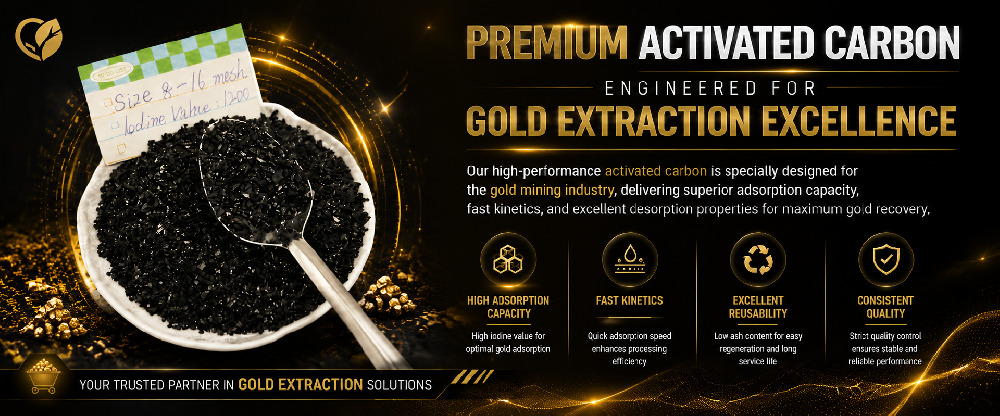
Activated carbon for gold recovery plays a central role in many modern gold-processing plants. After gold has been dissolved from ore into a leach solution, granular activated carbon captures the dissolved gold complex and transfers it to the next recovery stage.How Does Activated Carbon for Gold Recovery Work?
CIP, CIL, and CIC Processes for Gold Recovery
Carbon-in-Pulp
Carbon-in-Leach
Carbon-in-Column
How to Choose Activated Carbon for Gold Recovery
Gold Adsorption Rate
Gold-Loading Capacity
Hardness and Attrition Resistance
Particle-Size Distribution
Iodine Number
Ash and Moisture Content
Elution and Regeneration Performance
How to Evaluate Activated Carbon Quality Before Purchasing
Review the Certificate of Analysis
Test a Representative Sample
Compare Adsorption and Mechanical Performance Together
Conduct a Controlled Plant Trial
Audit the Supplier
How to Maximize Gold Recovery Efficiency with Activated Carbon
Maintain the Correct Carbon Inventory
Monitor Carbon Activity
Control Carbon Fines
Manage Carbon Fouling
Control the Adsorption Circuit
Common Mistakes When Buying Activated Carbon for Gold Recovery
Selecting Carbon Only by Iodine Number
Choosing the Lowest Price per Tonne
Ignoring Hardness and Attrition
Accepting an Unverified Raw-Material Claim
Comparing Results from Different Test Methods
Skipping the Plant Trial
Ignoring Batch Consistency
Frequently Asked Questions About Activated Carbon for Gold Recovery
Is coconut shell activated carbon the best option for gold recovery?
Is a higher iodine number always better for gold recovery?
Can activated carbon be used in small-scale gold mining?
Can activated carbon recover silver and other metals?
Can spent activated carbon be regenerated?
How often should gold recovery carbon be replaced?
What particle size should be used?
Conclusion
Recommended Reading
2026-09-16
Activated Carbon for Gold Recovery: How It Works and How to Choose the Right Carbon
2026-07-17
2026-09-20
2026-10-08
Detailed Guide: 7 Types of Activated Carbon and Their Unique Functions
2024-04-24
Get a customized solution
Filling in your phone and email information will help us get in touch with you in a timely manner and resolve your issue as soon as possible.