
Coconut Shell Activated Carbon Manufacturing Process: How Equipment Upgrades Improve Quality Stability
Release time:
2026-09-16
Author:
CarlCarbon
Source:
CarlCarbon
Abstract
Coconut Shell Activated Carbon Manufacturing Process: How Equipment Upgrades Improve Quality Stability
 |
Coconut Shell Activated Carbon is widely used in industries that require efficient adsorption performance, including gold recovery, water purification, air filtration, and industrial separation processes.
However, producing high-quality activated carbon is not only about selecting suitable coconut shells. The final performance depends on the entire manufacturing system, including:
Raw material selection
Carbonization technology
Activation process
Temperature control
Screening accuracy
Washing and purification
Quality inspection
For industrial buyers, the most important difference between ordinary activated carbon and premium activated carbon is often quality consistency.
A product with unstable adsorption performance, excessive moisture, low mechanical strength, or inconsistent particle size may increase operating costs and affect production efficiency.
To meet higher requirements from global customers, modern activated carbon manufacturers are continuously upgrading production equipment and manufacturing systems.
Through improvements in:
Activation equipment
Automated production control
Screening systems
Purification processes
Quality inspection systems
manufacturers can achieve more stable Coconut Shell Activated Carbon performance, reduce batch variation, and provide more reliable solutions for demanding industrial applications.
What Is Coconut Shell Activated Carbon?
Coconut Shell Activated Carbon is a porous carbon material produced from coconut shells through carbonization and activation processes.
During manufacturing, coconut shells are converted into carbon structures with a large number of micropores, creating strong adsorption capability.
Compared with other activated carbon materials, coconut shell activated carbon is commonly recognized for:
High microporous structure
Good adsorption efficiency
Strong mechanical strength
Low ash characteristics
Renewable raw material source
The unique pore structure makes coconut shell activated carbon suitable for applications where selective adsorption performance is required.
Typical applications include:
Gold recovery
Drinking water purification
Industrial wastewater treatment
Air purification
Chemical processing
Why Choose Coconut Shell Activated Carbon?
Different activated carbon materials have different pore structures and application advantages.
Coconut shell activated carbon is widely selected for industrial applications because of its balanced performance.
High Microporous Structure
The activation process creates abundant micropores inside coconut shell carbon.
These micropores provide:
Large adsorption capacity
Efficient molecular capture
Stable adsorption performance
For gold recovery applications, suitable pore structures help improve adsorption efficiency during CIP and CIL processes.
High Mechanical Strength
Mechanical strength is especially important in applications involving:
Continuous operation
Agitation
Transportation through pipelines
For gold mining applications, activated carbon with insufficient strength may break during circulation, creating carbon fines and increasing gold loss risk.
High-quality coconut shell activated carbon can achieve:
Mechanical Strength ≥99%
Higher strength helps:
Reduce carbon loss
Extend service life
Maintain stable operation
Low Moisture Content
Moisture content directly affects transportation efficiency and product utilization.
Through optimized drying and production control, premium products can achieve:
Moisture Content ≤4%
Lower moisture provides advantages including:
Higher effective activated carbon content per shipment
Reduced transportation of unnecessary water weight
Better storage stability
How Is Coconut Shell Activated Carbon Made?
The production of coconut shell activated carbon involves multiple controlled stages.
A stable manufacturing process is essential to achieve consistent adsorption performance.
The typical process includes:
Coconut shell selection
Carbonization
Activation
Screening and classification
Washing and purification
Quality inspection
Packaging and delivery
Each stage influences the final product quality.
Coconut Shell Selection and Raw Material Preparation
The quality of activated carbon starts with the selection of coconut shell raw materials.
Important factors include:
Raw material cleanliness
Carbon content
Moisture condition
Material consistency
Stable raw material supply helps manufacturers maintain consistent production performance.
Carbonization Process
Carbonization converts coconut shells into carbonized material under controlled conditions.
During this stage:
Volatile components are removed
Carbon structure is formed
Initial pore structure develops
The carbonization process influences:
Mechanical strength
Carbon structure
Activation efficiency
Poor carbonization control may result in unstable product performance.
Activation Process
Activation is the key stage that develops adsorption capability.
Through controlled activation, manufacturers adjust:
Pore structure
Surface characteristics
Adsorption performance
Modern production systems require precise control of:
Temperature
Activation time
Gas flow
Processing conditions
Equipment Upgrades Improve Coconut Shell Activated Carbon Quality Stability
The performance of activated carbon depends not only on process knowledge but also on manufacturing equipment capability.
Traditional production systems may experience challenges such as:
Uneven temperature distribution
Batch-to-batch variation
Inconsistent adsorption performance
Difficulty maintaining stable specifications
By upgrading production equipment, manufacturers can improve process stability and product consistency.
How Equipment Upgrades Improve Activated Carbon Quality Stability
For activated carbon manufacturers, improving product quality is not only about changing raw materials or adjusting formulas. The stability of the entire production system determines whether the final activated carbon can maintain consistent performance between different batches.
Production equipment upgrades can improve:
Activation accuracy
Carbon structure consistency
Mechanical strength
Moisture control
Particle size stability
Product repeatability
For customers in industries such as gold recovery, water treatment, and industrial adsorption, consistent quality is often more valuable than a single high-performance batch.
Smart Activation System Improves Pore Structure Control
The activation process determines the internal pore structure of coconut shell activated carbon.
Traditional production equipment may face challenges such as:
Uneven heat distribution
Inconsistent activation conditions
Different adsorption performance between batches
By upgrading activation systems, manufacturers can achieve more precise control over:
Activation temperature
Residence time
Gas distribution
Heating uniformity
A more stable activation environment helps produce activated carbon with:
More consistent pore development
Stable adsorption capacity
Predictable application performance
This is especially important for customers requiring strict quality standards.
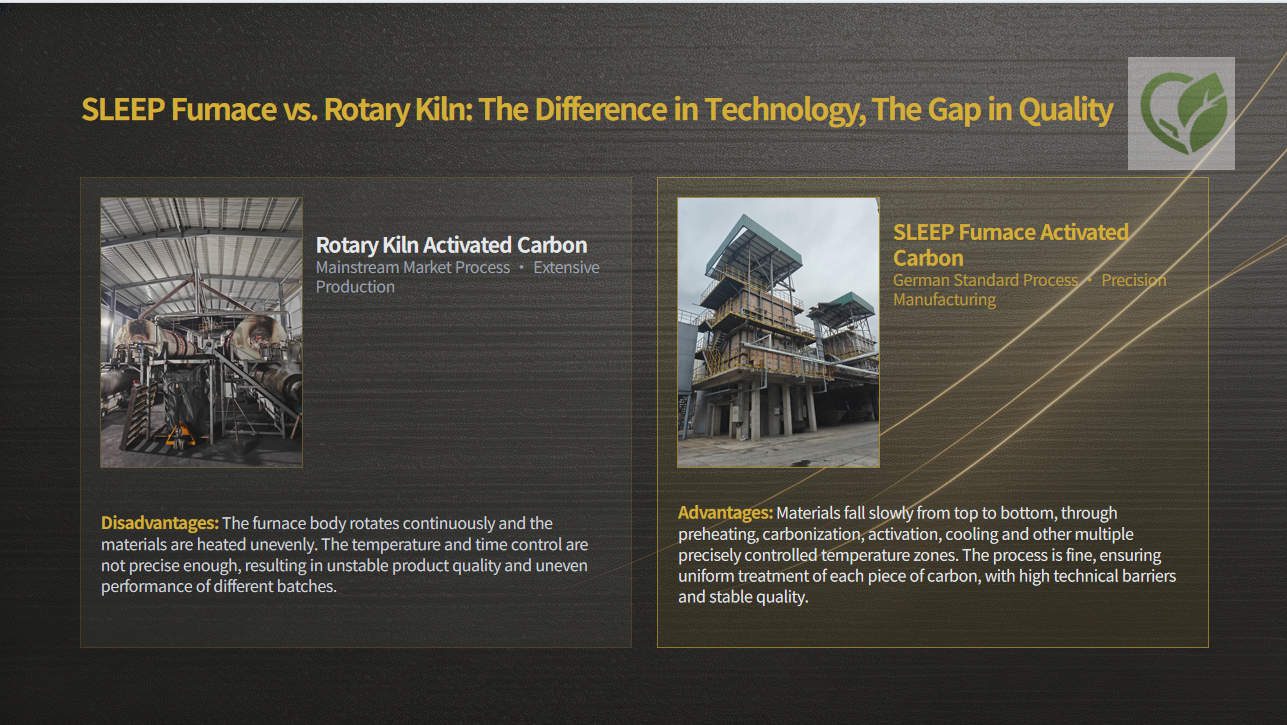
SLEP Furnace Technology for More Stable Activated Carbon Production
One of the important upgrades in advanced activated carbon manufacturing is the application of SLEP furnace technology.
Compared with traditional rotary furnace systems, SLEP furnace technology provides more controlled production conditions.
Traditional Rotary Furnace Limitations
Traditional rotary furnace production may experience:
Uneven material heating
Temperature fluctuations
Different activation levels within the same batch
Higher difficulty in maintaining premium-grade carbon consistency
These factors may lead to:
Variation in adsorption performance
Different mechanical strength between batches
Unstable product quality
Advantages of SLEP Furnace Technology
The SLEP furnace system provides multi-zone process control during:
Preheating
Carbonization
Activation
Cooling
This allows manufacturers to achieve:
More precise temperature management
More uniform activation conditions
Better control of carbon structure
As a result, each batch of coconut shell activated carbon can achieve more consistent performance.
Automated Production Systems Reduce Batch Variation
For industrial buyers, batch consistency is a critical purchasing factor.
Even if a single batch meets specifications, unstable production may create problems during long-term supply.
Production automation helps improve:
Raw material handling
Process parameter control
Production monitoring
Quality inspection
By reducing manual variation, manufacturers can better maintain:
Stable iodine value
Consistent adsorption performance
Uniform particle distribution
Reliable delivery quality
Advanced Screening Equipment Improves Product Consistency
Particle size distribution directly affects activated carbon performance.
For applications such as gold recovery, inconsistent particle sizes may influence:
Adsorption efficiency
Carbon circulation performance
Recovery stability
Upgraded screening systems help improve:
Particle size classification
Removal of excessive fines
Product uniformity
This allows manufacturers to provide activated carbon products with more stable specifications.
Upgraded Washing and Purification Systems Improve Carbon Quality
After activation, washing and purification processes influence the final product purity.
Improved washing systems help control:
Residual impurities
Ash content
Surface cleanliness
For customers requiring higher purity activated carbon, optimized washing processes can provide better performance consistency.
Special products such as Acid Washed Coconut Shell Activated Carbon require stricter purification control to meet specific industrial requirements.
Activated Carbon Quality Control: Key Specifications Buyers Should Check
When purchasing coconut shell activated carbon, buyers should evaluate multiple performance indicators rather than focusing on only one parameter.
Important specifications include:
| Specification | Importance |
|---|---|
| Mechanical Strength | Indicates resistance to breakage and carbon loss |
| Moisture Content | Affects effective carbon content and transportation efficiency |
| Ash Content | Influences purity and application performance |
| Iodine Value | Reflects adsorption capacity |
| Particle Size Distribution | Ensures application consistency |
For premium coconut shell activated carbon:
| Parameter | Performance Target |
|---|---|
| Mechanical Strength | ≥99% |
| Moisture Content | ≤4% |
| Ash Content | Controlled according to application requirements |
| Iodine Value | Stable batch performance |
Why Quality Stability Matters in Gold Recovery Applications
Gold recovery is one of the most demanding applications for coconut shell activated carbon.
In CIP and CIL processes, activated carbon acts as an adsorption carrier to capture gold from cyanide solution.
The performance of activated carbon directly affects:
Gold adsorption efficiency
Carbon consumption
Production stability
Operating costs
High Mechanical Strength Reduces Carbon Loss
During gold recovery processes, activated carbon experiences:
Continuous mixing
Transportation
Mechanical impact
Low-strength carbon may generate excessive carbon fines.
These fines can:
Increase carbon consumption
Carry away adsorbed gold
Reduce recovery efficiency
Activated carbon with mechanical strength ≥99% helps:
Reduce abrasion loss
Maintain carbon integrity
Improve long-term operational efficiency
Stable Pore Structure Improves Gold Adsorption Performance
The adsorption capability of activated carbon depends on:
Pore structure
Surface area
Carbon quality
Stable activation technology helps ensure:
Consistent adsorption performance
Reliable gold recovery efficiency
Reduced production fluctuations
Low Moisture Reduces Hidden Transportation Costs
For international buyers, moisture content directly affects shipping efficiency.
Activated carbon with moisture content ≤4% provides:
Higher active carbon proportion per shipment
Lower unnecessary transportation weight
Better storage performance
This is especially valuable for overseas mining customers purchasing large volumes.
Applications of Coconut Shell Activated Carbon
Coconut Shell Activated Carbon is widely used across multiple industries because of its excellent adsorption performance, stable structure, and renewable raw material characteristics.
Different industries have different requirements for activated carbon performance.
For example:
Gold recovery focuses on adsorption capacity and mechanical strength.
Water treatment focuses on impurity removal and stability.
Industrial purification focuses on selective adsorption performance.
A reliable activated carbon manufacturer needs not only production capability but also the ability to provide products suitable for different application environments.
Gold Recovery Activated Carbon Applications
Gold recovery is one of the most demanding applications for coconut shell activated carbon.
In modern mining operations, activated carbon is mainly used in:
Carbon-in-Pulp (CIP) processes
Carbon-in-Leach (CIL) processes
During these processes, activated carbon captures dissolved gold from cyanide solutions through adsorption.
The performance of activated carbon directly influences:
Gold recovery rate
Carbon consumption
Operating costs
Production stability
Why Activated Carbon Quality Matters in Gold Recovery
In gold extraction processes, activated carbon needs to maintain performance under continuous circulation conditions.
Key requirements include:
High Mechanical Strength
Mining operations involve:
Continuous agitation
Pump transportation
Repeated carbon circulation
Low-strength carbon may break into fine particles, causing:
Higher carbon loss
Increased replacement frequency
Potential gold loss
High-quality coconut shell activated carbon with:
Mechanical Strength ≥99%
can help reduce carbon wear and maintain stable operation.
Stable Adsorption Performance
The adsorption performance of activated carbon depends on:
Pore structure
Surface properties
Activation quality
A stable manufacturing process helps ensure consistent adsorption performance between batches.
This allows mining customers to achieve:
More predictable gold recovery
Stable production efficiency
Lower process fluctuations
Water Treatment Applications
Coconut shell activated carbon is also widely used in water purification.
Applications include:
Drinking water treatment
Industrial wastewater treatment
Process water purification
Its microporous structure allows it to adsorb:
Organic compounds
Chlorine
Odor-causing substances
Various dissolved impurities
Air Purification and Industrial Adsorption Applications
Beyond water treatment and gold recovery, coconut shell activated carbon is used in:
Air purification systems
Gas filtration
Chemical processing
Industrial emission control
Different applications require different activated carbon specifications.
Professional manufacturers can adjust:
Particle size
Adsorption characteristics
Surface properties
Purity level
according to customer requirements.
From Product Supply to Activated Carbon Solution Services
For industrial customers, purchasing activated carbon is not only about receiving products.
Long-term performance also depends on:
Product selection
Application matching
Process optimization
Technical support
Modern activated carbon suppliers are increasingly providing complete solutions rather than simple product delivery.
Technical Support for Gold Recovery Customers
For mining customers, professional support may include:
Process Optimization
By analyzing existing production conditions, technical teams can help optimize:
Activated carbon selection
Carbon dosage
Operating parameters
Recovery efficiency
Activated Carbon Regeneration Guidance
Spent activated carbon can sometimes be regenerated and reused.
Professional guidance can help customers improve:
Regeneration efficiency
Carbon service life
Operating cost control
This reduces unnecessary carbon replacement and improves resource utilization.
On-Site Technical Support
For large industrial projects, technical support can include:
Equipment adjustment assistance
Process troubleshooting
Production optimization recommendations
This helps customers maintain stable operations.
How to Select a Reliable Coconut Shell Activated Carbon Supplier
Choosing the right supplier is important for maintaining long-term product performance.
Industrial buyers should evaluate suppliers based on several aspects.
Production Capability
A reliable supplier should have:
Stable raw material supply
Mature production technology
Advanced manufacturing equipment
Sufficient production capacity
Production capability directly affects:
Product consistency
Delivery reliability
Long-term supply security
Manufacturing Process Control
Buyers should understand:
Carbonization technology
Activation method
Temperature control system
Screening process
Quality inspection procedures
A complete manufacturing system helps maintain stable product performance.
Quality Management System
Professional suppliers should provide consistent testing for:
Mechanical strength
Moisture content
Ash content
Iodine value
Particle size
Continuous quality monitoring ensures every batch meets customer requirements.
Export Capability and Supply Chain Support
For overseas buyers, supplier capability also includes:
Export experience
Packaging solutions
Logistics coordination
Stable delivery schedule
For large-volume customers, reliable supply capacity is as important as product quality.
Coconut Shell Activated Carbon Supplier with Integrated Capabilities
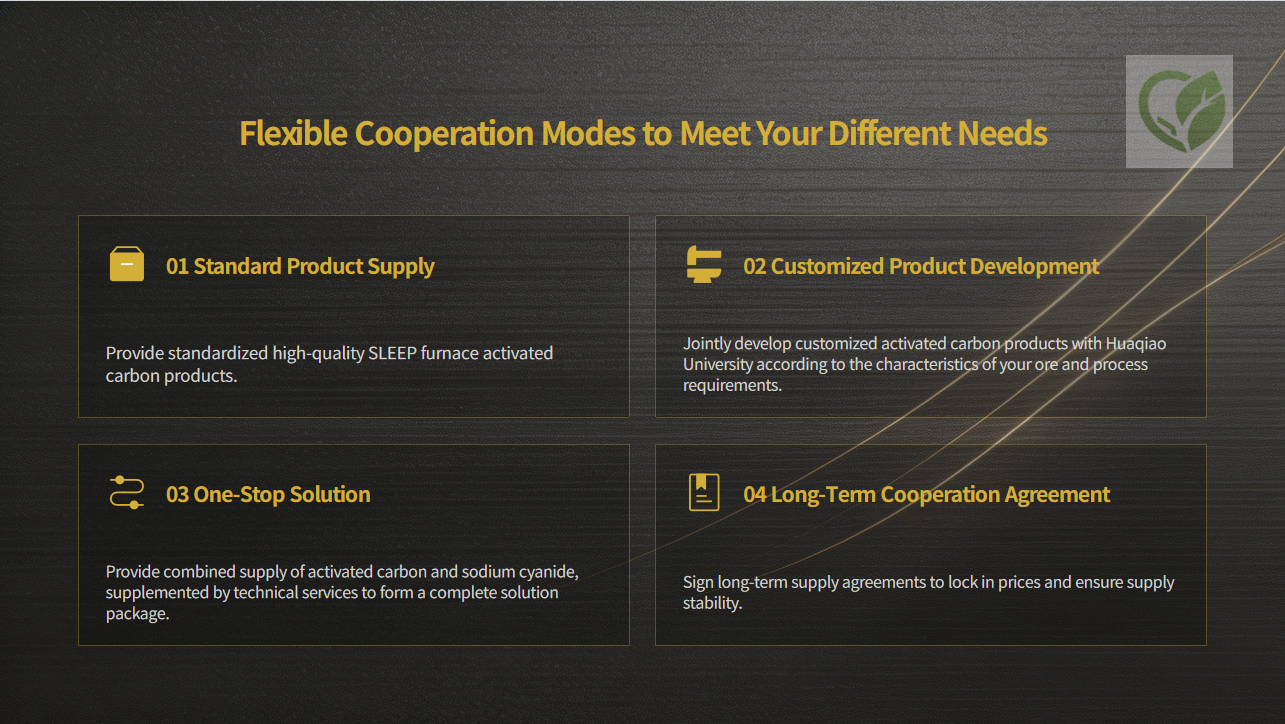
With upgraded production equipment and improved service systems, activated carbon manufacturers can provide customers with more than standard products.
A comprehensive solution may include:
High-quality coconut shell activated carbon supply
Customized specifications
Gold recovery activated carbon solutions
Process optimization support
Activated carbon regeneration guidance
Long-term supply cooperation
For mining and industrial customers, this approach helps reduce operational uncertainty and improve long-term efficiency.
FAQ About Coconut Shell Activated Carbon Manufacturing
How Is Coconut Shell Activated Carbon Made?
Coconut shell activated carbon is produced through several stages:
Coconut shell selection
Carbonization
Activation
Screening
Washing and purification
Quality inspection
Packaging
Each step affects the final adsorption performance and product consistency.
Why Is Coconut Shell Used to Make Activated Carbon?
Coconut shells are widely used because they can produce activated carbon with:
Developed microporous structure
Good adsorption performance
Strong mechanical properties
Renewable raw material advantages
What Makes High-Quality Coconut Shell Activated Carbon Different?
High-quality products usually have:
Stable adsorption performance
High mechanical strength
Controlled moisture content
Consistent particle size
Reliable batch quality
For industrial customers, consistency is often the key difference between ordinary and premium activated carbon.
Can Spent Activated Carbon Be Reactivated?
Yes.
Spent activated carbon can sometimes be regenerated through suitable processes.
The decision between regeneration and replacement depends on:
Carbon condition
Application requirements
Operating costs
Coconut shell activated carbon is often considered suitable for regeneration because of its strong structure.
What Specifications Should Buyers Check Before Purchasing?
Important specifications include:
Iodine value
Mechanical strength
Moisture content
Ash content
Particle size distribution
Application suitability
For mining applications, mechanical strength and adsorption stability are especially important.
Conclusion: Equipment Upgrades Create More Stable Coconut Shell Activated Carbon
The quality of Coconut Shell Activated Carbon depends on more than raw materials.
A stable product requires:
Advanced manufacturing equipment
Precise activation control
Complete quality inspection
Continuous process improvement
Through production line upgrades, improved activation systems, and stronger technical services, manufacturers can provide activated carbon with:
More stable adsorption performance
Higher mechanical strength
Lower moisture content
Better batch consistency
For customers in gold recovery, water treatment, and industrial purification, choosing a supplier with strong manufacturing capability and technical support can create long-term value beyond the product itself.
 |
Recommended Reading
2026-08-18
Granular Activated Carbon: A Complete Guide
2026-07-24
Activated Carbon for Sugar Decolorization: Process, Selection Guide and Common Problems
2026-07-03
2026-05-29
Coconut Shell Activated Carbon for Gold Recovery | Carl Carbon
2026-06-24
Get a customized solution
Filling in your phone and email information will help us get in touch with you in a timely manner and resolve your issue as soon as possible.