
Activated Carbon for Supercapacitors: EDLC Electrode Properties, Pore Structure and Material Selection
Release time:
2026-10-08
Author:
CarlCarbon
Source:
CarlCarbon
Abstract
Activated Carbon for Supercapacitors: EDLC Electrode Properties, Pore Structure and Material Selection
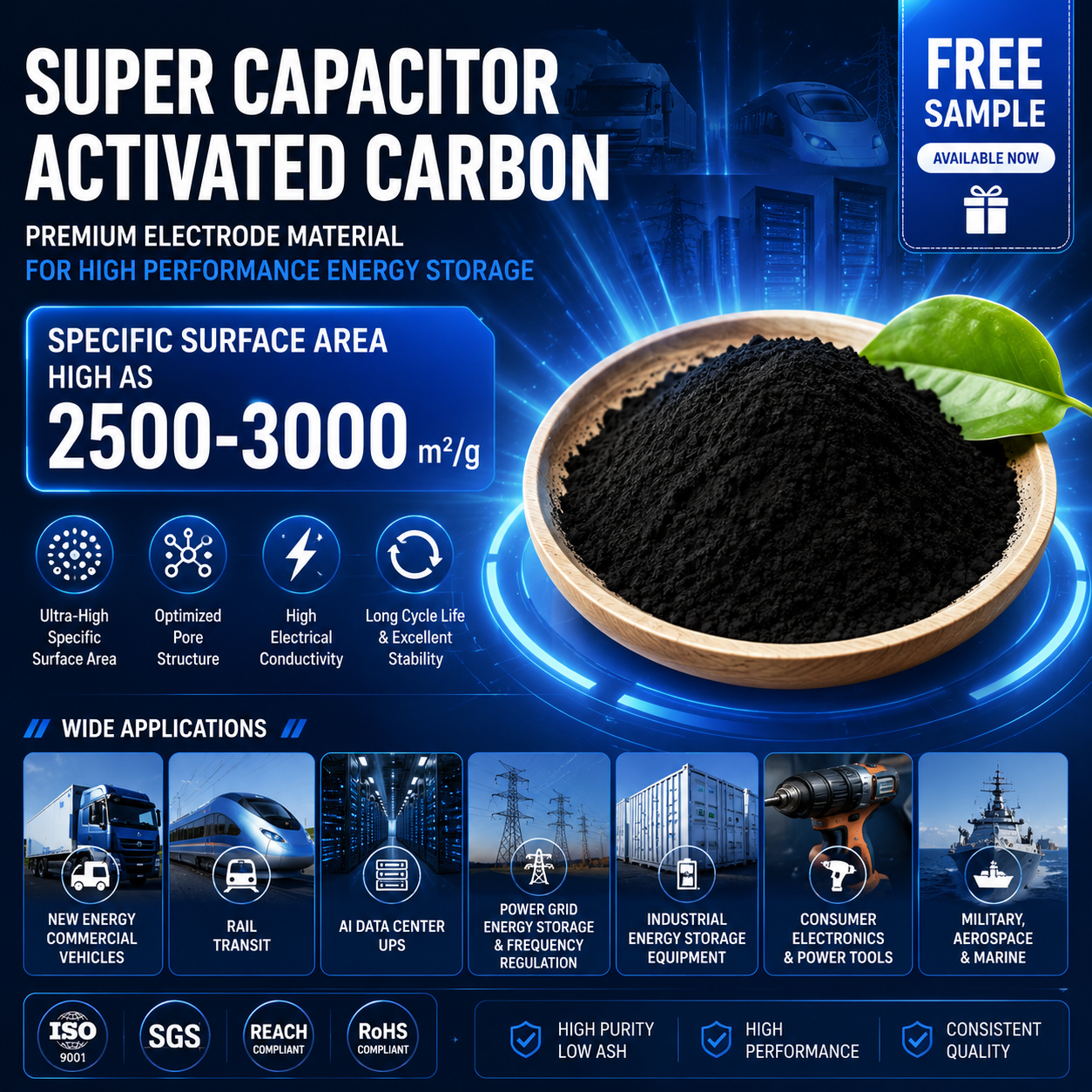 | 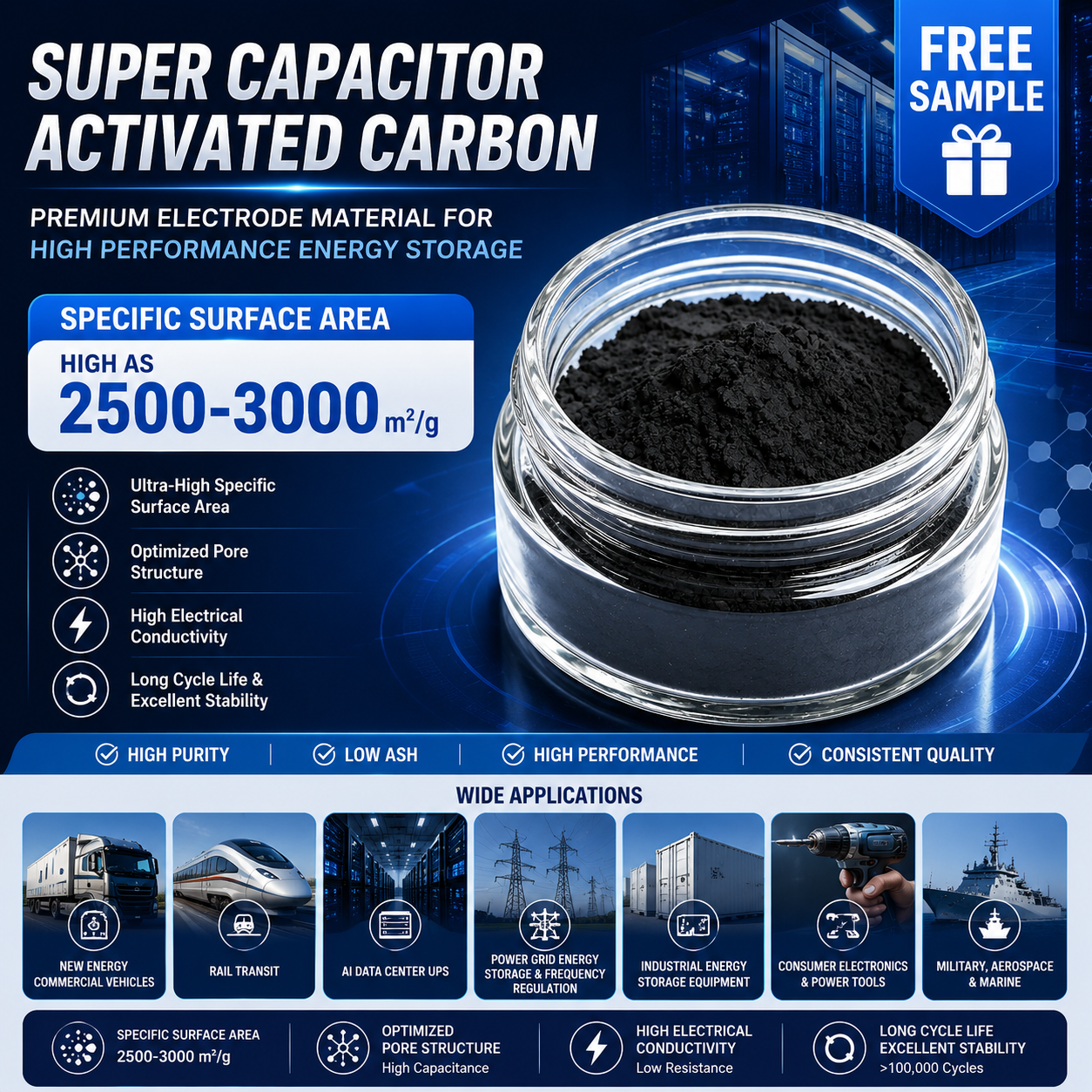 |
Activated carbon is one of the most widely used electrode materials in commercial supercapacitors, particularly in electrochemical double-layer capacitors (EDLCs).
Its popularity comes from a combination of properties that are difficult to achieve simultaneously with many advanced carbon materials:
High specific surface area
Tunable pore structure
Good chemical stability
Relatively low material cost
Mature industrial production
Compatibility with large-scale electrode manufacturing
However, selecting activated carbon for supercapacitors involves much more than choosing the material with the highest BET surface area.
Actual electrochemical performance depends on whether electrolyte ions can access the pore network efficiently, how quickly charge can move through the electrode, the surface chemistry of the carbon, material purity, particle characteristics, and the interaction between activated carbon and the complete electrode formulation.
For manufacturers of EDLC electrodes, supercapacitor cells, and energy-storage materials, understanding these relationships is essential when selecting an activated carbon grade.
This guide explains how activated carbon works in supercapacitor electrodes, which properties influence capacitance, why pore structure matters, how activated carbon is manufactured, and what buyers should consider when selecting a supplier.
Activated Carbon for Supercapacitor Electrodes
Activated carbon for supercapacitor electrodes is a highly porous carbon material designed to provide a large electrochemically accessible interface between the electrode and electrolyte.
In an EDLC, electrical energy is stored primarily through charge separation at this interface rather than through the bulk chemical reactions that dominate conventional battery systems.
Activated carbon is particularly suitable for this application because controlled carbonization and activation can produce a complex network of:
Micropores
Mesopores
Larger transport pores
These pores create a large internal surface area while allowing electrolyte ions to move into and out of the carbon structure.
A typical supercapacitor electrode contains more than activated carbon alone. It may also include:
Conductive additives
Polymer binders
Current collectors
Electrolytes
The activated carbon nevertheless remains the principal charge-storage material in many commercial EDLC designs.
Its performance therefore has a direct influence on:
Specific capacitance
Internal resistance
Energy density
Power capability
Cycle stability
For this reason, electrode manufacturers should evaluate activated carbon as an electrochemical material rather than simply as a high-surface-area adsorbent.
Activated Carbon for EDLCs: How Charge Storage Works
Activated carbon for EDLCs stores energy through the formation of an electrical double layer at the interface between the porous carbon electrode and the electrolyte.
When voltage is applied to the supercapacitor, positively and negatively charged ions migrate toward electrodes of opposite polarity.
Instead of undergoing extensive chemical conversion, these ions accumulate close to the carbon surface.
The larger the usable electrode-electrolyte interface, the greater the potential for charge storage.
This explains why porous carbon materials are so important in EDLC technology.
From Porous Carbon to Stored Charge
The energy-storage process can be understood in several stages.
First, electrolyte ions move through the electrode structure.
They then enter accessible pores within the activated carbon.
Finally, charge accumulates at the carbon-electrolyte interface and forms the electrical double layer.
The efficiency of this process depends on both the amount of available surface and the accessibility of that surface.
A pore that contributes to BET surface area but cannot be reached efficiently by electrolyte ions may provide limited practical benefit.
That distinction is one of the most important concepts when evaluating EDLC electrode material.
EDLCs Compared with Pseudocapacitors
EDLCs primarily store energy through electrostatic charge separation.
Pseudocapacitors, by contrast, rely more heavily on fast surface or near-surface Faradaic reactions.
Materials such as some metal oxides and conducting polymers are often associated with pseudocapacitive behavior.
Hybrid supercapacitors may combine characteristics of both systems.
For activated-carbon-focused applications, EDLCs remain the most relevant commercial technology because activated carbon provides the porous, chemically stable surface required for double-layer charge storage.
Pore Structure of Activated Carbon for Supercapacitors
The pore structure of activated carbon for supercapacitors is one of the most important factors controlling electrode performance.
A common misconception is that higher surface area automatically results in higher capacitance.
In practice, surface area alone does not determine electrochemical performance.
The key question is:
How much of the internal surface is actually accessible to electrolyte ions under operating conditions?
Why Surface Area Alone Is Not Enough
Two activated carbons can have similar BET surface areas but exhibit different capacitance.
This can happen because they differ in:
Pore size distribution
Ion accessibility
Pore connectivity
Surface chemistry
Electrical conductivity
A carbon dominated by pores that are poorly matched to the electrolyte may not use its total surface efficiently.
Therefore, effective supercapacitor carbon design requires both high surface area and suitable pore architecture.
Micropores and Charge Storage
Micropores provide a large proportion of the internal surface area of activated carbon.
They are particularly important for maximizing charge-storage sites.
However, the usefulness of micropores depends on whether electrolyte ions can enter them.
Ion size, solvent structure, electrolyte chemistry, and pore width all influence accessibility.
This is why a simple statement such as “more micropores always means higher capacitance” is not technically sufficient.
Mesopores and Ion Transport
Mesopores can help improve ion movement through the carbon network.
They often act as transport channels connecting the external electrode environment to smaller charge-storage pores.
A hierarchical pore structure containing both storage-oriented micropores and transport-oriented larger pores can therefore improve practical electrochemical performance.
Pore Size Distribution
Pore size distribution is generally more informative than surface area alone when comparing candidate electrode carbons.
A well-designed pore structure can help balance:
Capacitance
Ion transport
Rate capability
Resistance
The ideal distribution depends on the electrolyte system and cell design.
There is no single universal pore-size specification suitable for every supercapacitor.
Key Properties of Activated Carbon for Supercapacitor Electrodes
The performance of activated carbon for supercapacitor electrodes depends on a group of interrelated physical, chemical, and electrochemical properties.
Buyers should therefore avoid evaluating the material using only one specification.
| Property | Why It Matters |
|---|---|
| Specific Surface Area | Provides potential electrode-electrolyte interface |
| Pore Size Distribution | Determines ion accessibility and transport |
| Electrical Conductivity | Influences resistance and power performance |
| Surface Chemistry | Affects wettability and electrode-electrolyte interaction |
| Purity | Helps reduce unwanted electrochemical reactions |
| Ash Content | Indicates inorganic residue |
| Particle Size | Influences coating, packing and electrode processing |
| Moisture | Important for storage and some electrolyte systems |
| Batch Consistency | Supports repeatable cell performance |
Specific Surface Area
High specific surface area is useful because EDLC charge storage occurs at the carbon-electrolyte interface.
However, it should always be evaluated together with pore accessibility.
The most useful surface is not necessarily the largest theoretical surface, but the surface that electrolyte ions can reach efficiently.
Electrical Conductivity
Activated carbon must participate in a conductive electrode network.
If electrical resistance is too high, the cell may experience:
Higher equivalent series resistance
Reduced power performance
Greater energy loss
Electrode manufacturers often combine activated carbon with conductive additives to optimize conductivity.
Surface Functional Groups
The surface functionalization of activated carbon for supercapacitors can affect:
Electrolyte wettability
Ion accessibility
Surface polarity
Interfacial behavior
Electrochemical stability
Oxygen-containing or nitrogen-containing functional groups may modify surface behavior.
In some systems they can improve wettability or contribute additional electrochemical activity.
Excessive or poorly controlled surface functionality, however, may also increase unwanted reactions or affect long-term stability.
Surface chemistry therefore needs to be controlled rather than simply maximized.
Purity and Ash Content
High-purity activated carbon is especially important for electrochemical applications.
Inorganic impurities may influence:
Leakage current
Electrolyte stability
Cell voltage
Long-term cycling
Self-discharge behavior
For this reason, high-purity activated carbon for supercapacitors often requires more stringent purification and quality control than general-purpose activated carbon used for adsorption.
Particle Size and Electrode Processing
Particle size can affect:
Slurry dispersion
Coating uniformity
Electrode density
Conductive network formation
Ion transport pathways
The correct particle specification depends on the electrode formulation and manufacturing process.
A technically suitable carbon should therefore be evaluated not only in powder form but also in the intended electrode formulation.
Supercapacitor Performance Parameters Affected by Activated Carbon
Activated carbon characteristics ultimately need to translate into useful cell performance.
Several commonly evaluated supercapacitor parameters include:
Specific Capacitance
Specific capacitance reflects the amount of charge stored relative to electrode mass.
It is influenced by:
Accessible surface area
Pore structure
Surface chemistry
Electrolyte
Testing conditions
Values obtained using different test methods should not always be compared directly.
Equivalent Series Resistance
Equivalent series resistance, commonly abbreviated as ESR, influences power delivery and efficiency.
Carbon conductivity, electrode formulation, current collector contact, and electrolyte resistance can all contribute to ESR.
Energy Density
The energy stored by a supercapacitor depends on both capacitance and operating voltage.
This means activated carbon performance cannot be separated completely from electrolyte selection.
Power Density
Power capability depends strongly on how rapidly ions and electrons can move through the system.
For this reason, pore connectivity and conductivity can be as important as total surface area.
Cycle Stability
One of the major advantages of EDLC technology is long cycle life.
Stable activated carbon should maintain:
Structural integrity
Surface chemistry
Pore accessibility
Electrochemical performance
through repeated charging and discharging.
Preparation of Activated Carbon for Supercapacitor Electrodes
The preparation of activated carbon for supercapacitor electrodes strongly influences the final pore structure and electrochemical behavior.
A typical production process may include:
Raw material selection
Carbonization
Activation
Washing and purification
Drying
Milling and particle-size control
Quality testing
Carbonization
Carbonization converts the precursor into a carbon-rich structure.
During this stage, volatile components are removed and the basic carbon framework is formed.
Carbonization conditions can influence:
Structural stability
Carbon yield
Initial pore development
Subsequent activation behavior
Physical Activation
Physical activation commonly uses gases such as steam or carbon dioxide at elevated temperatures.
The process gradually develops the pore network by controlled gasification of the carbon structure.
Advantages can include:
Good process controllability
Reduced residual chemical activating agents
Suitability for industrial-scale manufacturing
Chemical Activation
Chemical activation uses activating agents to promote pore formation.
Depending on the process, chemical activation can generate:
High surface area
Tunable pore structures
Different surface chemical characteristics
However, the activating agent, washing process, residual impurities, and production economics must all be considered.
Purification
For electrode-grade applications, purification is particularly important.
Residual inorganic compounds or process chemicals can affect electrochemical stability.
A controlled washing and purification process helps reduce unwanted impurities and improve product consistency.
Particle Size Control
After activation and purification, activated carbon may be milled and classified to achieve the required particle distribution.
Particle control is important because supercapacitor electrode production may involve:
Slurry coating
Dry electrode processing
Calendering
High-density electrode formation
Material specifications should therefore match the intended manufacturing method.
Activated Carbon vs Other Carbonaceous Electrode Materials
The broader category of carbonaceous electrode materials for supercapacitors includes activated carbon, graphene, carbon nanotubes, carbon aerogels, and carbide-derived carbon.
Each material offers different advantages.
| Carbon Material | Main Advantages | Main Considerations |
|---|---|---|
| Activated Carbon | Mature, scalable, high surface area, cost-effective | Conductivity and pore accessibility require optimization |
| Graphene | High conductivity and attractive intrinsic properties | Restacking, processing and cost can be challenges |
| Carbon Nanotubes | Strong conductive network and good rate capability | Cost and surface area utilization may limit large-scale use |
| Carbon Aerogels | Tunable 3D porous structure | Manufacturing complexity can be higher |
| Carbide-Derived Carbon | Highly controllable pore structure | Production route and cost may be more specialized |
Activated carbon remains commercially important because it provides a practical balance among:
Performance
Manufacturing scalability
Material availability
Process maturity
Cost
Advanced carbon materials can deliver valuable performance in specific designs, but they do not automatically replace activated carbon in every commercial EDLC.
In some cases, they are used together with activated carbon to improve conductivity or create composite electrode structures.
How to Choose Activated Carbon for Supercapacitor Applications
Choosing activated carbon for supercapacitors should begin with the actual cell design rather than with a single carbon specification.
Different applications may prioritize:
Higher capacitance
High power
Low ESR
Long cycle life
High-voltage stability
Compact electrode density
The carbon should therefore be matched to the electrolyte, electrode formulation, and performance target.
Start with the Electrolyte System
Electrolyte chemistry influences:
Ion size
Operating voltage
Pore accessibility
Surface compatibility
Activated carbon suitable for one electrolyte system may not deliver identical performance in another.
Evaluate Pore Structure, Not Only BET Surface Area
A supplier should be able to provide relevant pore-structure data rather than relying exclusively on a headline surface-area number.
Important information may include:
BET surface area
Micropore volume
Mesopore volume
Pore size distribution
Consider Electrode Formulation Compatibility
The same activated carbon can behave differently depending on:
Binder system
Conductive additive
Carbon loading
Electrode density
Coating thickness
For this reason, laboratory testing in the customer's actual formulation is essential.
Check Purity and Consistency
For industrial production, batch consistency can be as important as peak laboratory performance.
Buyers should evaluate whether the supplier can maintain consistent:
Pore structure
Particle size
Ash content
Moisture
Electrochemical performance
over repeated production batches.
Activated Carbon Supplier for Supercapacitors
Selecting an activated carbon supplier for supercapacitors requires more than checking whether a supplier can produce high-surface-area carbon.
A technically capable supplier should understand that electrode-grade activated carbon has different requirements from activated carbon used in water treatment, gas purification, or general adsorption.
Important supplier capabilities include:
Stable raw material sourcing
Controlled carbonization and activation
High-purity processing
Particle-size control
Batch quality management
Technical data support
Sample evaluation
Scale-up capability
High-Purity Carbon and Sample-First Evaluation
For supercapacitor applications, a sample-first workflow is generally more reliable than selecting material only from a specification sheet.
A practical qualification process may include:
Define electrolyte and electrode system.
Identify target carbon parameters.
Obtain representative samples.
Prepare test electrodes.
Measure capacitance, ESR and cycling behavior.
Compare several carbon grades.
Validate pilot-scale performance.
Confirm batch consistency before commercial supply.
This approach helps connect material specifications with actual cell performance.
Why Batch Consistency Matters
A carbon grade that performs well once but changes significantly between batches can create problems during commercial electrode manufacturing.
Batch variation may affect:
Slurry rheology
Coating quality
Electrode density
Capacitance
Resistance
Reliable suppliers should therefore focus not only on maximum performance, but also on repeatable manufacturing.
Activated Carbon for Supercapacitors FAQ
Why is activated carbon used in supercapacitors?
Activated carbon provides a high internal surface area and tunable pore structure that allow electrolyte ions to form an electrical double layer on the electrode surface. It also offers good chemical stability, scalable production, and relatively competitive cost.
Is higher surface area always better for supercapacitors?
No. Higher BET surface area does not automatically produce higher capacitance. The surface must also be accessible to electrolyte ions. Pore size distribution, connectivity, conductivity, and surface chemistry all influence practical performance.
What pore size is best for supercapacitor activated carbon?
There is no universal optimum pore size. The most suitable pore structure depends on electrolyte ion size, solvent system, operating voltage, and desired rate capability. A combination of charge-storage pores and ion-transport pathways is often important.
What is the difference between EDLCs and pseudocapacitors?
EDLCs primarily store charge through electrostatic ion accumulation at the electrode-electrolyte interface. Pseudocapacitors rely more heavily on fast Faradaic surface reactions. Activated carbon is most strongly associated with EDLC electrodes.
Is activated carbon better than graphene for supercapacitors?
Neither material is universally better. Graphene can provide excellent conductivity and attractive electrochemical properties, while activated carbon offers mature manufacturing, high porosity, scalability, and lower cost. The best material depends on the application.
What specifications should buyers check when purchasing supercapacitor activated carbon?
Important factors include:
Surface area
Pore size distribution
Purity
Ash content
Moisture
Particle size
Conductivity
Surface chemistry
Batch consistency
Electrochemical testing in the intended electrode formulation is also important.
Can activated carbon be used in other energy-storage applications?
Yes. Activated carbon can also be used in hybrid capacitors, conductive composites, battery-related systems, and other energy-storage technologies, depending on its pore structure, purity, surface chemistry, and electrical properties.
Conclusion
Activated Carbon for Supercapacitors remains one of the most important electrode-material categories in commercial electrochemical double-layer capacitors.
Its performance is determined not by surface area alone, but by the interaction between:
Pore structure
Ion accessibility
Electrical conductivity
Surface chemistry
Purity
Particle characteristics
Electrode formulation
For EDLC manufacturers, a well-designed activated carbon should provide an effective balance between charge-storage surface and ion-transport efficiency.
For buyers, the most reliable selection process is therefore not simply to choose the highest BET value. It is to identify the carbon whose pore architecture, purity, particle properties, and electrochemical behavior match the actual electrolyte and electrode system.
A qualified activated carbon supplier for supercapacitors should be able to support this process through consistent manufacturing, technical data, sample evaluation, and reliable batch-to-batch quality.
Recommended Reading
Coconut Shell Activated Carbon: A Complete Guide
2026-07-24
Detailed Guide: 7 Types of Activated Carbon and Their Unique Functions
2024-04-24
Activated Carbon for Gold Recovery: How It Works and How to Choose the Right Carbon
2026-07-17
Activated Carbon for Sugar Decolorization: Process, Selection Guide and Common Problems
2026-07-03
Activated Carbon for Monosodium Glutamate: MSG Decolorization and Refining Applications
2026-08-21
Get a customized solution
Filling in your phone and email information will help us get in touch with you in a timely manner and resolve your issue as soon as possible.