
Coconut Shell Activated Carbon: A Complete Guide
Release time:
2026-07-24
Author:
CarlCarbon
Source:
CarlCarbon
Abstract
Coconut Shell Activated Carbon: A Complete Guide
 |  |
Coconut shell activated carbon is widely used in water treatment, air purification, gas processing, food and beverage production, chemical refining, and gold recovery. Its porous structure, high mechanical strength, and suitability for adsorption make it an important purification material for both consumer filtration products and large industrial treatment systems.
However, coconut shell activated carbon is not a single standardized product. Performance can vary considerably according to the raw material, activation process, particle size, pore distribution, purity, and intended application.
This guide explains what coconut shell activated carbon is, how it is manufactured, how adsorption works, where it is used, which technical specifications matter, and how buyers can select an appropriate grade.
What Is Coconut Shell Activated Carbon?
Coconut shell activated carbon is a porous carbon material produced from coconut shells through carbonization and activation.
Coconut shells are first converted into charcoal under controlled heating conditions. The charcoal is then activated at high temperature using steam, carbon dioxide, or another activation method. Activation develops and enlarges the internal pore network, creating a large surface area on which contaminants can be adsorbed.
Activated carbon should not be confused with ordinary coconut shell charcoal. Charcoal has undergone carbonization, while activated carbon has received an additional activation treatment that creates a more developed pore structure and substantially improves adsorption performance.
Activated carbon can be produced from several carbon-rich materials, including:
Coconut shells
Bituminous coal
Lignite
Wood
Peat
Other agricultural by-products
Coconut shells frequently produce a dense, durable activated carbon with a pore structure that is rich in micropores. These characteristics make coconut-based carbon suitable for removing many low-molecular-weight contaminants and for applications where resistance to abrasion is important.
Activated carbon contains a network of internal pores. According to Kuraray, activated carbon products can have internal surface areas ranging from approximately 500 to 2,500 square meters per gram, although the actual value depends on the raw material and production process.
Common Forms of Coconut Shell Activated Carbon
Coconut shell activated carbon is available in several physical forms.
Granular activated carbon
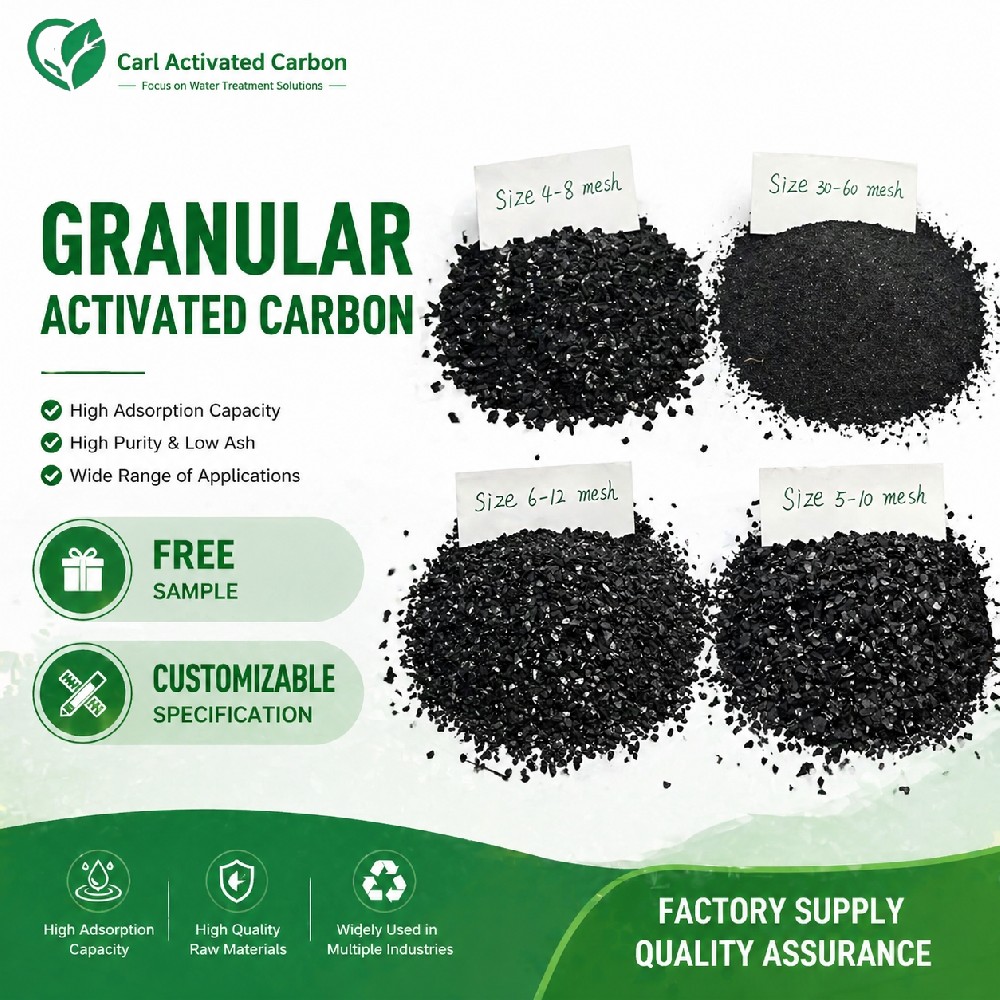
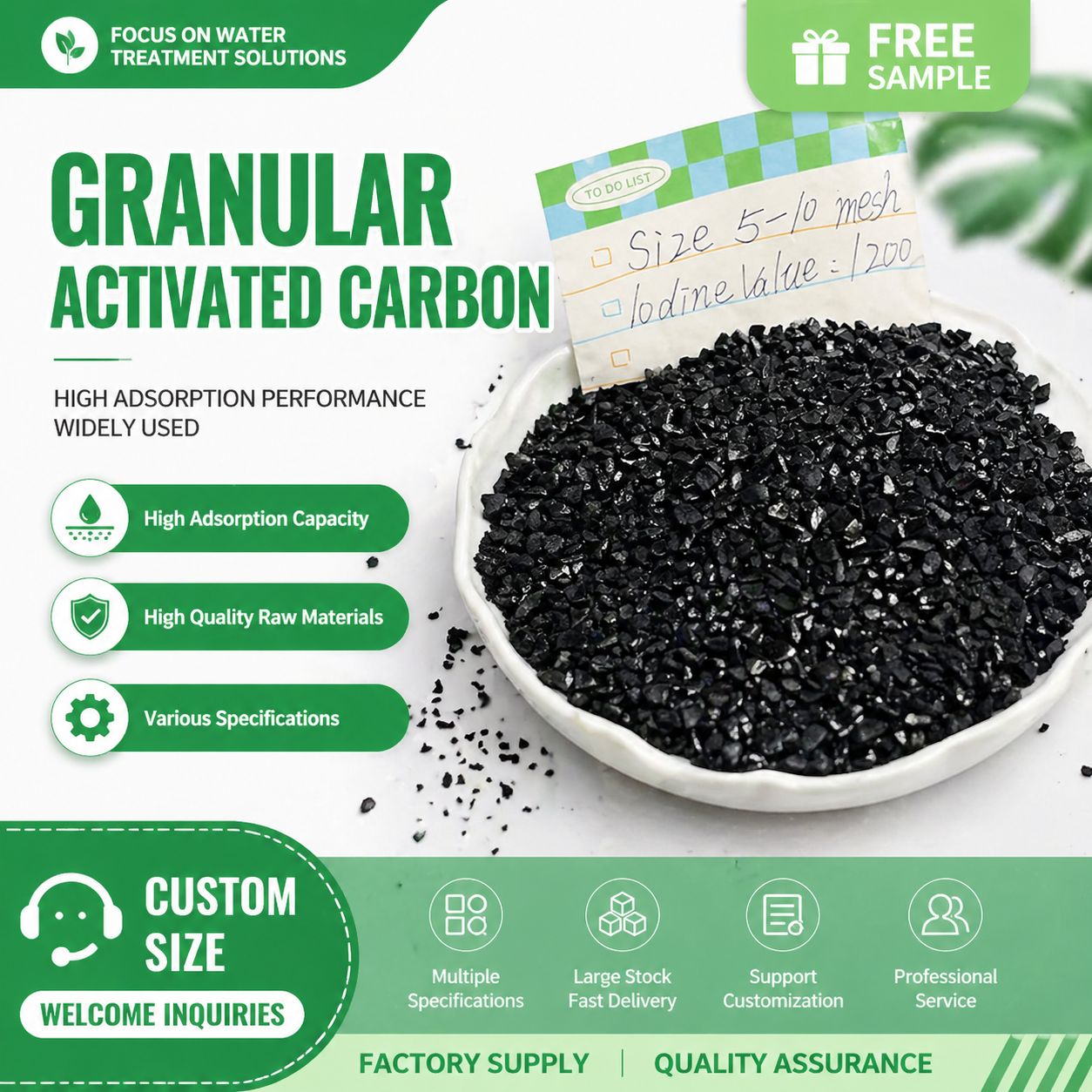
Granular activated carbon, commonly abbreviated as GAC, consists of particles large enough to be retained in filter beds, pressure vessels, cartridges, and adsorption columns. Coconut shell granular activated carbon is widely used in water filtration, air purification, solvent recovery, and gold processing.
Powdered activated carbon
Powdered activated carbon, known as PAC, contains much smaller particles. It can be dosed directly into a liquid treatment process and later removed by sedimentation or filtration. PAC is frequently used for temporary or seasonal treatment requirements, including taste, odor, and organic contaminant control in water treatment plants.
Pelletized activated carbon
Pelletized carbon is formed into cylindrical particles. Its uniform shape can provide lower pressure drop and reduced dust generation in gas-phase systems. The feedstock and formulation may vary, so buyers should confirm whether a specific pelletized product is coconut-based.
How Is Coconut Shell Activated Carbon Made and How Does It Work?
The performance of coconut shell activated carbon begins with raw material selection and continues through carbonization, activation, washing, particle sizing, and quality control.
Raw Material Selection
Manufacturers select mature, hard coconut shells and remove excessive fiber, soil, stones, and other foreign materials.
Raw material consistency influences the density, strength, ash content, and pore development of the finished activated carbon. Variations in shell quality and processing conditions may lead to differences between production batches.
Carbonization
The cleaned shells are heated in an oxygen-limited environment. This process removes volatile components and converts the shells into carbon-rich coconut shell charcoal.
Carbonization creates an initial pore structure, but the resulting charcoal does not yet have the adsorption capacity expected from activated carbon.
Activation
The charcoal is exposed to steam, carbon dioxide, or chemical activating agents at elevated temperatures. Steam activation is commonly used for coconut shell activated carbon.
During activation, controlled reactions remove portions of the carbon structure and develop a network of microscopic pores. Activation conditions must be managed carefully. Insufficient activation may produce limited adsorption capacity, while excessive activation may reduce yield, density, and mechanical strength.
Activated carbon is manufactured by reacting carbon-based raw materials with gases or chemicals at high temperatures, creating or enlarging the pores responsible for adsorption.
Washing, Drying, and Screening
After activation, the carbon may be washed to reduce ash, soluble salts, residual chemicals, and other impurities. Acid washing may be used when low extractable metals or high product purity is required.
The material is then dried, crushed, and screened into specified particle-size ranges, such as:
4 × 8 mesh
6 × 12 mesh
8 × 16 mesh
8 × 30 mesh
12 × 30 mesh
12 × 40 mesh
20 × 50 mesh
The required mesh size depends on the treatment system, flow rate, acceptable pressure drop, adsorption kinetics, and intended service life.
Quality Testing and Packaging
Finished products may be tested for:
Iodine number
Surface area
Particle-size distribution
Hardness
Moisture
Ash content
Apparent density
pH
Carbon tetrachloride activity
Water-soluble ash
Acid extractables
The carbon is then packed in moisture-resistant bags, bulk bags, or other suitable containers.
How Coconut Shell Activated Carbon Works
Coconut shell activated carbon removes contaminants primarily through adsorption.
During adsorption, molecules in water, air, gas, or process liquid travel into the carbon’s pore structure and accumulate on its internal surface. This differs from absorption, in which one substance penetrates and becomes distributed throughout another material.
Adsorption may involve physical attraction, chemical interactions, catalytic reactions, or a combination of mechanisms. The dominant mechanism depends on the contaminant and the activated carbon grade.
Several factors influence adsorption performance:
Contaminant molecular size
Contaminant concentration
Pore-size distribution
Carbon surface chemistry
Contact time
Temperature
Water or gas humidity
pH
Competing substances
Carbon dosage
Bed depth
Flow velocity
A high surface area alone does not guarantee the best performance. The pores must be accessible and appropriately sized for the target molecules.
Why Choose Coconut Shell Activated Carbon?
Coconut shell activated carbon is selected for many purification systems because it frequently combines high adsorption activity with strong physical durability.
Micropore-Rich Structure
Coconut-based activated carbon is frequently associated with a relatively high proportion of micropores. Micropores can be effective for adsorbing many small organic molecules, low-concentration contaminants, odors, and volatile substances.
However, pore distribution is influenced by activation conditions as well as the raw material. Some specialized coconut-shell grades may contain a broader range of micro-, meso-, and macropores for decolorization and larger-molecule applications.
High Mechanical Hardness
Coconut shells can produce dense and mechanically strong activated carbon. High hardness helps reduce particle breakage, carbon loss, and fine-powder generation during transportation, backwashing, loading, regeneration, and repeated process use.
This feature is particularly valuable in gold recovery circuits and industrial adsorption vessels where the carbon experiences frequent movement and abrasion.
Low Ash and High Purity
Well-manufactured coconut shell activated carbon can have relatively low ash content and low levels of inorganic impurities.
Low ash may be important in:
Drinking water treatment
Food and beverage processing
Pharmaceutical purification
High-purity chemical processing
Applications sensitive to leachable metals
Actual ash content must still be confirmed through the product specification and batch test report.
Suitable for Liquid- and Gas-Phase Applications
Coconut shell activated carbon can be manufactured in grades for water treatment, process-liquid purification, air filtration, vapor adsorption, solvent recovery, and gas treatment.
Different applications require different pore structures, particle sizes, surface treatments, and quality standards. A water-treatment grade should not automatically be assumed to perform effectively in a gas-phase system.
Renewable Raw Material
Coconut shells are an agricultural by-product. Converting them into activated carbon creates value from biomass that may otherwise have limited use.
This renewable origin can support environmental objectives, although the total environmental impact also includes energy consumption, activation efficiency, emissions control, transportation, service life, regeneration, and end-of-life management.
Important Limitations
Coconut shell activated carbon does not remove every contaminant.
Unmodified activated carbon may have limited effectiveness for:
Dissolved salts
Water hardness minerals
Nitrates
Fluoride
Many inorganic ions
Some heavy metals
Microorganisms
Highly water-soluble compounds
Contaminants that do not adsorb readily
Activated carbon filtration should not be presented as a universal replacement for reverse osmosis, ion exchange, membrane filtration, disinfection, or specialized chemical treatment.
The United States Environmental Protection Agency notes that activated carbon can remove many organic chemicals but does not effectively remove all microbes, dissolved minerals, or salts.
Adsorption capacity also decreases as the carbon becomes loaded. Spent carbon must eventually be replaced, regenerated, or disposed of according to the contaminants it contains.
Top Applications of Coconut Shell Activated Carbon
The uses of coconut activated carbon extend across environmental treatment, industrial production, resource recovery, and consumer filtration.
Water and Wastewater Treatment
Coconut shell activated carbon is widely used as an activated carbon filter medium in:
Drinking water treatment
Residential water filters
Under-sink filtration systems
Refrigerator filters
Municipal water plants
Industrial process-water systems
Wastewater polishing
Groundwater remediation
Beverage production
Aquariums and specialty water systems
Depending on the product and operating conditions, coconut shell carbon may help reduce:
Chlorine
Taste and odor compounds
Volatile organic compounds
Pesticides
Solvents
Dissolved organic contaminants
Natural organic matter
Selected disinfection by-products
Other adsorbable organic chemicals
Commercial coconut-based GAC products are used for removing dissolved organic contaminants from water, wastewater, and process liquids.
The phrase “removes contaminants” should be supported by contaminant-specific data. Removal claims depend on the carbon grade, influent concentration, flow rate, empty bed contact time, competing organics, temperature, pH, and breakthrough criterion.
Air and Gas Purification
Coconut shell activated carbon is used in gas-phase adsorption systems for:
Odor control
Volatile organic compound removal
Solvent vapor recovery
Industrial exhaust treatment
Indoor air filters
Respiratory protection filters
Process-gas purification
Hydrocarbon vapor control
Relative humidity can affect gas-phase performance. Water molecules may occupy adsorption sites and reduce capacity for certain organic vapors, particularly under high-humidity conditions.
Some gases require chemically impregnated activated carbon. Standard coconut shell carbon should not be assumed to remove ammonia, hydrogen sulfide, mercury, formaldehyde, or acid gases without suitable testing or surface treatment.
Gold Recovery
Coconut shell granular activated carbon is widely used in carbon-in-pulp and carbon-in-leach gold recovery systems.
The carbon adsorbs dissolved gold complexes from the process solution. It is then separated from the slurry, stripped, regenerated, and returned to the circuit.
High hardness is particularly important because carbon fines can lead to gold loss and operational inefficiency. Commercial coconut-shell-based gold recovery carbons are designed for high gold loading, rapid adsorption kinetics, and resistance to abrasion in CIL and CIP systems.
Food and Beverage Processing
Suitable grades may be used for:
Decolorization
Taste and odor control
Sugar and sweetener purification
Edible oil processing
Beverage purification
Alcohol treatment
Ingredient refining
Products used in food-contact applications must comply with the relevant regulatory and purity requirements in the destination market.
Pharmaceutical and Chemical Purification
Coconut activated carbon can be used to remove colors, trace organics, process impurities, and unwanted reaction by-products from pharmaceutical and chemical liquids.
The selected product may require controlled pH, low ash, low extractable metals, validated purity, and application-specific documentation.
Environmental Remediation
Activated carbon can also be used in groundwater, soil, sediment, and industrial remediation projects. The carbon may be installed in treatment vessels, permeable systems, filter media, or specialized in-situ amendments.
Application engineering is essential because contaminant mixtures, natural organic matter, suspended solids, and site conditions can influence adsorption capacity and system life.
Coconut Shell Activated Carbon Technical Specifications
Technical specifications help buyers compare products, but no single parameter can fully predict treatment performance.
A product with the highest iodine number is not automatically the best carbon for every application. Buyers should evaluate the complete pore structure, physical properties, contaminant characteristics, and operating conditions.
| Specification | What It Indicates | Why It Matters |
|---|---|---|
| Iodine number | Relative indicator of microporosity | Common screening parameter for liquid-phase carbon |
| BET surface area | Estimated total internal surface area | Helps characterize pore development |
| Mesh size | Particle-size range | Influences pressure drop, kinetics, and retention |
| Hardness | Resistance to breakage and abrasion | Important for transport, backwashing, and regeneration |
| Ash content | Inorganic residue in the carbon | Relevant to purity and potential extractables |
| Moisture | Water contained in the supplied product | Affects net carbon content and storage |
| Apparent density | Mass per unit bulk volume | Used for vessel sizing and carbon inventory |
| pH | Acidity or alkalinity of carbon extract | Important for sensitive processes |
| CTC activity | Gas-phase adsorption indicator | Commonly used for vapor-phase products |
| Water-soluble ash | Soluble inorganic content | Relevant to high-purity liquid applications |
Iodine Number
Iodine number is one of the most frequently quoted specifications for activated carbon. It is expressed in milligrams of iodine adsorbed per gram of carbon under defined test conditions.
A higher iodine number often indicates greater micropore development, but it should not be treated as a universal measure of adsorption capacity for every contaminant.
ASTM D4607 describes iodine number as a relative indicator of activated carbon porosity. ASTM also states that iodine number does not necessarily measure the carbon’s ability to adsorb other substances and that its relationship with surface area cannot be generalized across different raw materials and pore structures.
Particle Size and Mesh Size
Smaller particles generally provide shorter diffusion paths and faster adsorption kinetics. They may also create greater pressure drop and increase the possibility of carbon carryover.
Larger particles may reduce pressure drop but require sufficient contact time for contaminants to reach the internal adsorption sites.
The correct particle size should be selected according to:
Equipment design
Flow rate
Bed depth
Backwashing requirements
Target contaminant
Required contact time
Acceptable pressure loss
Hardness and Abrasion Resistance
Hardness indicates the carbon’s ability to resist mechanical damage. It is especially important in reusable filter beds, gold-recovery systems, moving-bed processes, and applications involving backwashing or thermal regeneration.
Low-hardness carbon can generate fines, increase product loss, block downstream equipment, or reduce hydraulic performance.
Ash Content
Ash represents the inorganic portion remaining after the carbon is burned under specified test conditions.
Low ash can be beneficial, but the acceptable level depends on the application. Buyers should also consider the composition of the ash and the amount of water-soluble or acid-extractable material.
Moisture and Apparent Density
Moisture affects the amount of dry activated carbon contained in a shipment. Apparent density affects storage volume, transport economics, vessel capacity, and the total mass of carbon installed in a system.
ASTM Committee D28 maintains activated carbon test methods covering iodine number, moisture, apparent density, total ash, hardness, particle-size distribution, pH, and other physical properties.
Coconut Shell vs Other Activated Carbons
Coconut shell, coal-based, and wood-based activated carbons are not interchangeable in every system. Raw material influences the initial carbon structure, while activation and post-treatment determine the final pore distribution and surface chemistry.
| Selection Factor | Coconut Shell Activated Carbon | Coal-Based Activated Carbon | Wood-Based Activated Carbon |
|---|---|---|---|
| Typical pore tendency | Frequently micropore-rich | Often broader pore distribution | Frequently higher mesopore and macropore contribution |
| Mechanical strength | Commonly high | Moderate to high, depending on grade | Often lower in granular form |
| Ash level | Frequently low | May be higher | Depends on source and processing |
| Common applications | Water, air, solvents, gold recovery | Municipal water, wastewater, industrial treatment | Decolorization and larger organic molecules |
| Raw material origin | Agricultural by-product | Fossil carbon source | Biomass source |
| Available forms | GAC, PAC, specialized grades | GAC, PAC, pellets | Commonly PAC and specialized GAC |
These descriptions are useful starting points, but they are not absolute rules.
A heavily activated coconut shell carbon may have a broader pore structure than a lightly activated grade. Coal-based carbon may outperform coconut carbon for some larger molecules or complex contaminant mixtures. Wood-based powdered carbon may be particularly effective for color bodies and larger organic molecules.
Material selection should therefore be based on performance data rather than raw material reputation alone.
How to Select the Best Coconut Shell Activated Carbon
The best coconut shell activated carbon is the grade that meets the treatment objective under the actual operating conditions.
Define the Application
Begin by identifying whether the carbon will be used for:
Drinking water
Wastewater
Process liquids
Air purification
Solvent recovery
Food processing
Pharmaceutical production
Gold recovery
Environmental remediation
A carbon optimized for drinking water may not be appropriate for gold recovery or vapor-phase treatment.
Identify the Target Contaminants
Prepare a clear list of target compounds and their expected concentrations.
The supplier may also need information about:
Competing contaminants
Total organic carbon
pH
Temperature
Humidity
Suspended solids
Flow rate
Required outlet concentration
Operating cycle
Replacement schedule
The phrase “high-performance activated carbon” has limited meaning without a defined contaminant and test condition.
Select the Correct Carbon Form and Particle Size
Choose between granular, powdered, or pelletized activated carbon according to the process design.
For GAC systems, mesh size should be matched to the vessel, retention screens, backwash velocity, and pressure-drop limitations.
Review the Complete Technical Data Sheet
Do not compare products using iodine number alone.
Review:
Raw material
Activation method
Iodine number
BET surface area
Particle-size distribution
Hardness
Ash
Moisture
Apparent density
pH
CTC activity where relevant
Extractable metals
Certifications
Packaging
Shelf-life recommendations
Check Regulatory and Quality Documentation
Depending on the market and application, buyers may request:
Certificate of Analysis
Technical Data Sheet
Safety Data Sheet
Food-contact compliance
Drinking-water certification
Quality-management certification
Batch traceability
Country-of-origin documents
Heavy-metal testing
Microbiological controls
Halal or kosher documentation
Certification requirements should be confirmed for the destination country and final use.
Request Samples and Performance Testing
Laboratory testing, pilot testing, adsorption isotherms, rapid small-scale column tests, or full-scale trials can provide more useful evidence than a general specification comparison.
Testing is particularly important when:
The influent contains multiple contaminants
Natural organic matter is present
Outlet limits are strict
Carbon consumption represents a major operating cost
The existing carbon has experienced early breakthrough
The application involves food, pharmaceuticals, or high-purity chemicals
Evaluate the Manufacturer and Supplier
A reliable coconut shell activated carbon factory or supplier should provide more than a product price.
Buyers should examine:
Raw material sourcing
Production capacity
Activation control
Washing and screening capabilities
Laboratory equipment
Batch consistency
Quality records
Packaging controls
Export experience
Technical support
Supply continuity
Custom particle sizing
Regeneration options
Complaint and traceability procedures
Where possible, request recent batch reports rather than relying only on typical specifications.
Frequently Asked Questions About Coconut Shell Activated Carbon
What contaminants does coconut shell activated carbon remove?
Coconut shell activated carbon can adsorb chlorine, taste and odor compounds, many volatile organic compounds, solvents, pesticides, and other organic contaminants. The exact removal capacity depends on the carbon grade, contaminant concentration, pore structure, contact time, and treatment conditions.
Contaminant-specific testing is required before making guaranteed removal claims.
Does coconut shell activated carbon remove heavy metals?
Standard coconut shell activated carbon is not universally effective for heavy metals. Some metals may be reduced by specialized, impregnated, modified, or composite carbon media.
Heavy-metal treatment may require ion exchange, reverse osmosis, precipitation, activated alumina, or another dedicated treatment method.
Does coconut shell activated carbon remove bacteria and viruses?
Activated carbon alone should not be treated as a reliable disinfection method. Bacteria may also grow in carbon filters when maintenance and replacement are inadequate.
Microbiological control may require ultraviolet treatment, chlorination, membrane filtration, boiling, or another validated disinfection process.
Is coconut shell activated carbon environmentally friendly?
Coconut shells are renewable agricultural by-products, which gives coconut-based carbon an advantage over fossil raw materials in some sustainability assessments.
Environmental performance still depends on production energy, activation yield, air-emission controls, water consumption, transport, regeneration, service life, and disposal practices.
Is coconut shell charcoal the same as coconut shell activated carbon?
No. Coconut shell charcoal is produced through carbonization. Coconut shell activated carbon undergoes an additional activation process that develops a more extensive pore network and greater adsorption capacity.
Is coconut shell activated carbon better than coal-based carbon?
Coconut shell carbon often offers high hardness, low ash, and a micropore-rich structure. Coal-based carbon often provides a broader pore-size distribution.
Neither material is superior for every contaminant. Product selection should be based on pore structure, adsorption testing, operating conditions, supply requirements, and total treatment cost.
How long does coconut shell activated carbon last?
Service life can range from a relatively short operating period to several years, depending on:
Contaminant concentration
Carbon quantity
Flow rate
Contact time
Competing substances
Temperature
Humidity
Pretreatment
Breakthrough limit
A fixed replacement period should not be applied to every system.
Can coconut shell activated carbon be regenerated?
Some spent granular activated carbon can be thermally or chemically regenerated. Regeneration removes adsorbed contaminants and restores part of the carbon’s adsorption capacity.
The suitability of regeneration depends on the carbon grade, contaminant type, spent-carbon classification, transport cost, regeneration loss, and required product purity. Some commercial coconut-shell grades are specifically designed for chemical or thermal regeneration.
Which coconut shell activated carbon mesh size should I choose?
The appropriate mesh size depends on the application and system design.
Fine particles may provide faster adsorption but higher pressure drop. Coarser particles may support higher flow rates but require adequate bed depth and contact time.
Consult the equipment designer or carbon supplier before changing the particle-size range in an existing treatment system.
Where can I buy reliable coconut shell activated carbon?
Purchase from a manufacturer or supplier that provides traceable specifications, current batch test reports, technical documentation, representative samples, and application support.
Price should be evaluated together with adsorption capacity, hardness, carbon loss, system life, freight cost, supply consistency, and disposal or regeneration expenses.
Final Considerations
Coconut shell activated carbon is a versatile purification material with applications in water filtration, air treatment, gas processing, food production, chemical purification, environmental remediation, and gold recovery.
Its high hardness, developed pore structure, and relatively low impurity content make it suitable for many demanding applications. These advantages do not eliminate the need for careful product selection.
Raw material is only one part of activated carbon performance. Activation conditions, particle size, pore distribution, surface chemistry, purity, equipment design, and operating conditions must all be considered.
Before placing a bulk order, review the technical data sheet, request a representative sample, confirm compliance requirements, and test the selected carbon against the actual contaminant stream.
Need help selecting coconut shell activated carbon for your filtration or industrial process? Contact our technical team with your application, target contaminants, flow conditions, and required specifications.
Recommended Reading
Activated Carbon Parameters Explained: Iodine Value, Methylene Blue Value, CTC and More
2026-08-25
Detailed Guide: 7 Types of Activated Carbon and Their Unique Functions
2024-04-24
Activated Carbon Water Filter: How It Works, What It Removes, and How to Choose One
2026-07-08
Granular Activated Carbon: A Complete Guide
2026-07-24
Coconut Shell Activated Carbon: A Complete Guide
2026-07-24
Get a customized solution
Filling in your phone and email information will help us get in touch with you in a timely manner and resolve your issue as soon as possible.