
Shisha Charcoal Guide: Types, Performance and How to Choose the Right Hookah Charcoal
Release time:
2026-09-03
Author:
CarlCarbon
Source:
CarlCarbon
Abstract
Shisha Charcoal Guide: Types, Performance and How to Choose the Right Hookah Charcoal
 |  |
Shisha charcoal is the heat source used with hookah or shisha equipment to heat the smoking mixture placed in the bowl. The quality of the charcoal directly influences heat stability, burn duration, ash production, odor and overall heat-management consistency.
The terms shisha charcoal and hookah charcoal are often used for the same product. Different markets may prefer different terminology, but buyers are generally evaluating similar characteristics: how easily the charcoal lights, how long it burns, how stable the heat remains and how much ash or unwanted odor it produces.
Shisha charcoal is manufactured from several raw materials, including coconut shells, wood, sawdust and agricultural shells. It can also be divided into natural charcoal and quick-light charcoal according to the way it is produced and ignited.
Among these options, coconut shell shisha charcoal has become an important category for lounges, distributors, private-label brands and wholesale buyers because it can provide long burning time, high density, stable heat and relatively low ash when manufactured properly.
However, raw material alone does not determine product quality. Carbonization conditions, charcoal formulation, binder quality, compression density, moisture, ash content, cube dimensions and packaging all affect final performance.
This guide explains the main types of shisha charcoal, compares coconut shell, wood and pistachio-shell charcoal, and outlines the factors buyers should consider when sourcing charcoal for hookah applications.
What Is Shisha Charcoal?
Shisha charcoal is specially prepared charcoal used as a controlled heat source in hookah applications.
Rather than placing the charcoal directly into the smoking mixture, heated charcoal is normally positioned above the bowl, often on foil or in a heat-management device. The charcoal provides sustained heat during use.
Good hookah charcoal should deliver heat in a controlled and predictable way.
Important performance characteristics include:
Burn duration
Heat output
Heat stability
Ash production
Odor during lighting and burning
Shape consistency
Mechanical strength
Ease of ignition
The performance of the charcoal influences heat management throughout a session.
Charcoal that burns too quickly may require frequent replacement. Charcoal with unstable heat output can make temperature control more difficult. Excessive ash can also increase handling and cleaning requirements.
For commercial buyers, consistency between production batches is therefore just as important as the performance of a single sample.
Types of Shisha Charcoal
Types of Shisha Charcoal can be classified according to both raw material and ignition method.
The two broad groups are natural shisha charcoal and quick-light hookah charcoal.
Within natural charcoal, common raw materials include coconut shells, wood, sawdust and other biomass materials.
Natural Shisha Charcoal
Natural shisha charcoal is produced from carbonized biomass and normally requires an external heat source for ignition.
Common raw materials include:
Coconut shells
Hardwood
Sawdust
Pistachio shells
Other agricultural biomass
Natural charcoal is often selected when users want longer burn duration and more stable heat.
Its actual performance depends heavily on raw-material quality and manufacturing conditions.
Quick-Light Hookah Charcoal
Quick-light hookah charcoal contains components designed to make ignition faster.
It can normally be lit more easily than natural charcoal, making it convenient for situations where fast preparation is important.
Its advantages include:
Faster ignition
Convenient handling
Less equipment required for lighting
However, quick-light products and natural charcoal have different performance characteristics, so buyers should evaluate them according to their target market rather than treating them as interchangeable products.
Coconut Shell Shisha Charcoal
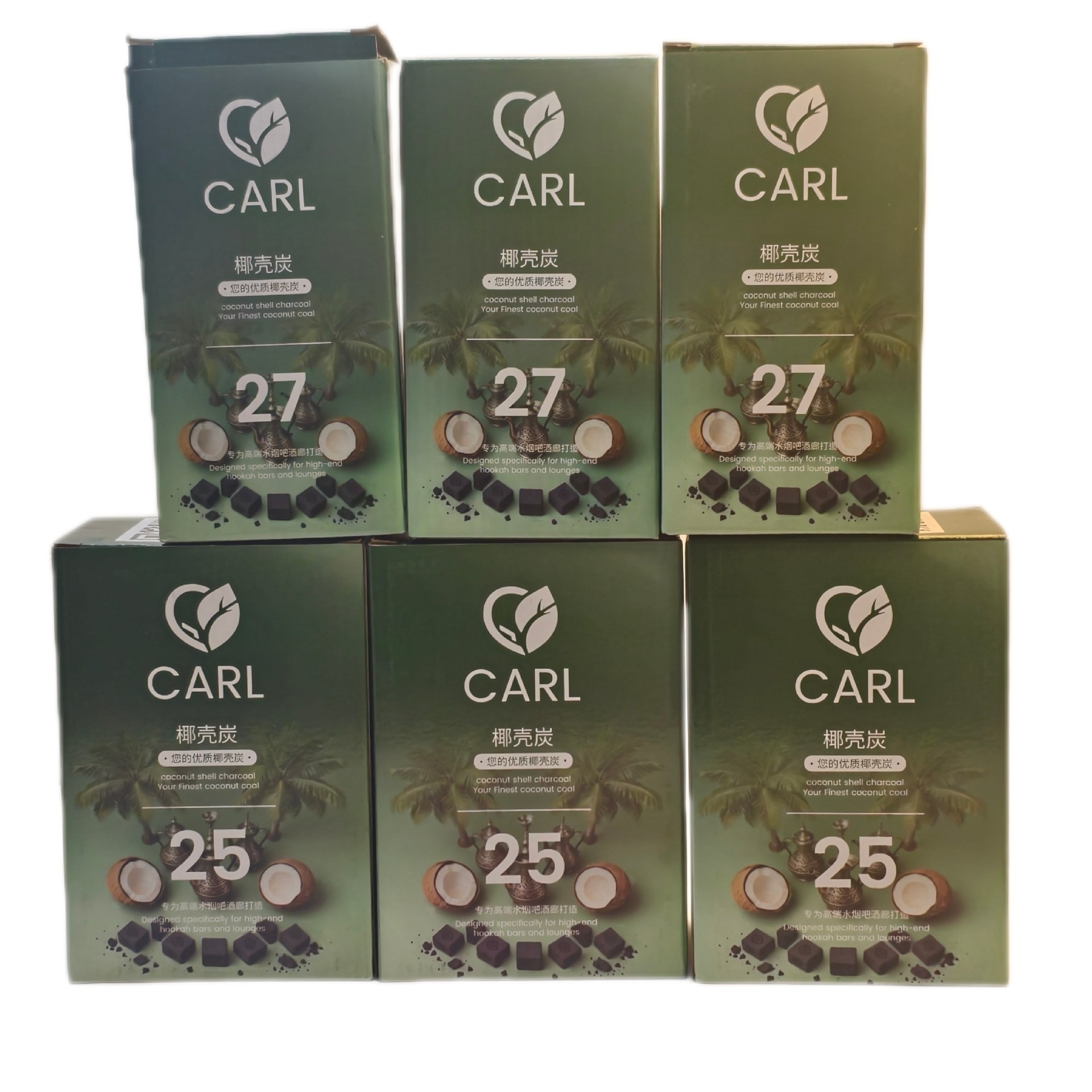
Coconut shell shisha charcoal is produced primarily from carbonized coconut shells that are processed, ground, mixed, compressed and formed into standardized shapes.
Common forms include:
Cubes
Flat pieces
Hexagonal pieces
Finger charcoal
Customized shapes
High-quality coconut charcoal is valued for its density, mechanical strength and consistent burning characteristics.
It is widely used for premium retail products, hookah lounges and private-label charcoal brands.
Wood and Sawdust Charcoal
Wood and sawdust charcoal can also be used for shisha charcoal production.
Performance varies considerably depending on:
Wood species
Carbonization temperature
Binder system
Density
Ash content
Wood-based products may provide competitive pricing, but odor, ash and heat characteristics should be tested carefully.
Pistachio Shell Charcoal
Pistachio shells and similar agricultural residues can also be carbonized and processed into shisha charcoal.
These products may offer useful thermal performance depending on production quality.
However, supply availability, raw-material consistency and regional sourcing can influence whether they are suitable for large-scale commercial programs.
Why Coconut Shell Shisha Charcoal Is Widely Used
Coconut Shell Shisha Charcoal has become one of the most important product categories in the hookah charcoal market.
Its popularity is mainly related to the physical characteristics of coconut shell carbon and the performance that can be achieved through controlled manufacturing.
Long Burning Time
Coconut shell charcoal can be compressed into relatively dense pieces.
Higher density generally allows the charcoal to burn more gradually than loosely structured charcoal.
Longer burn duration can reduce the frequency of charcoal replacement during use.
Stable Heat Output
Heat stability is one of the most important characteristics of hookah charcoal.
A well-manufactured coconut charcoal cube can provide relatively consistent heat during its useful burning period.
This makes heat management easier and helps reduce frequent adjustments.
Low Ash Potential
High-quality coconut charcoal can produce relatively low ash compared with some lower-density charcoal products.
Ash performance still depends on raw-material purity, carbonization and formulation.
For commercial buyers, ash should therefore be evaluated through actual burn testing rather than relying only on supplier descriptions.
High Density and Mechanical Strength
Coconut shells can produce a hard charcoal structure after proper carbonization and processing.
This helps finished cubes resist:
Chipping
Cracking
Powder formation
Damage during transport
Mechanical strength becomes particularly important for export shipments and retail packaging.
Renewable Raw Material
Coconut shells are an agricultural by-product of coconut processing.
Using shell material for charcoal production creates another commercial use for this biomass resource.
For buyers evaluating raw-material sourcing, this can be an additional advantage.
Shisha Charcoal Types Comparison: Coconut Shell vs Wood vs Pistachio
Different raw materials create different charcoal characteristics.
The following comparison provides a practical overview.
| Performance Factor | Coconut Shell Charcoal | Wood / Sawdust Charcoal | Pistachio Shell Charcoal |
|---|---|---|---|
| Burn Duration | Generally long | Medium to long depending on density | Medium to long |
| Heat Stability | Usually strong when properly manufactured | Depends heavily on formulation | Can be stable with good processing |
| Ash Level | Often relatively low | Varies by wood and process | Depends on raw-material purity |
| Density | Usually high | Variable | Medium to high |
| Mechanical Strength | Usually strong | Varies considerably | Depends on formulation |
| Odor Control | Low when sufficiently carbonized | Depends on wood and carbonization | Depends on processing |
| Raw-Material Availability | Strong in coconut-producing regions | Widely available | More regionally limited |
| Commercial Positioning | Premium and mainstream hookah charcoal | Economy to mid-range | Alternative / regional product |
This comparison should be treated as a sourcing reference rather than an absolute performance ranking.
Manufacturing quality can have a greater effect than raw material alone.
A poorly carbonized coconut shell product may perform worse than a carefully manufactured wood-based charcoal. Buyers should therefore evaluate both raw material and finished-product specifications.
How to Choose High-Quality Shisha Charcoal
How to Choose Shisha Charcoal is especially important for wholesalers, distributors, hookah lounges and private-label buyers because small quality differences can become significant across large order volumes.
Several factors deserve particular attention.
Raw Material
Ask the supplier to clearly identify the raw material.
For coconut products, determine whether the charcoal is genuinely produced from coconut shell carbon and whether other charcoal materials are blended into the formulation.
Raw-material consistency affects:
Density
Ash
Burning behavior
Odor
Heat output
Burn Time
Burn duration is one of the most visible performance indicators.
However, longer burn time should not be considered in isolation.
A charcoal cube that burns for a long period but provides insufficient or unstable heat may still perform poorly.
Buyers should evaluate:
Burn duration + usable heat duration + heat stability
together.
Heat Stability
High-quality charcoal should provide reasonably stable heat during the main burning period.
Sudden changes in heat output make temperature control more difficult.
For B2B sourcing, side-by-side burn testing under the same conditions is more useful than comparing supplier claims.
Ash Content
Ash level affects both appearance and handling.
Important points include:
Total ash quantity
Ash color
Whether ash remains attached or breaks apart easily
Whether the cube maintains its structure while burning
High mineral content in raw material can increase ash.
Odor
Poorly carbonized material or inappropriate binders can create noticeable odor during ignition or burning.
For shisha applications, buyers generally prefer charcoal with minimal unwanted odor.
Actual ignition and burn testing is therefore essential.
Moisture
Excessive moisture can affect:
Ignition
Burning stability
Product weight
Storage
Charcoal should be stored and packaged in a way that limits moisture uptake.
Size and Shape Consistency
Common cube sizes vary by market and brand.
Whatever specification is selected, dimensional consistency is important.
Uneven cubes can create:
Uneven heat
Different burn times
Packaging problems
Negative customer feedback
Buyers should define acceptable dimensional tolerances before mass production.
Mechanical Strength
Charcoal needs to survive:
Manufacturing
Packing
Container loading
International transport
Warehouse handling
Final retail distribution
Excessive breakage creates dust and reduces the number of usable pieces in each box.
Binder Quality
Compressed shisha charcoal usually requires a binder to maintain shape.
Binder formulation can affect:
Strength
Ignition behavior
Ash
Odor
Burn characteristics
For food-contact-adjacent consumer applications, buyers should also obtain appropriate material and compliance documentation from suppliers where relevant to their market.
How to Properly Light and Manage Shisha Charcoal
Different hookah charcoal types require different ignition methods.
Natural coconut charcoal generally needs more sustained heating than quick-light charcoal.
Lighting Natural Coconut Hookah Coals
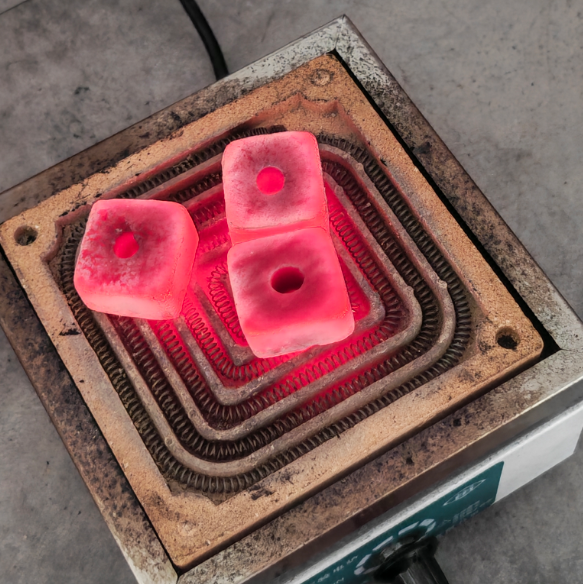
Natural coconut charcoal should be heated until the cube is properly ignited across its surface rather than used while large sections remain unlit.
During heating, the charcoal can be rotated so different surfaces receive sufficient heat.
Incomplete ignition can result in uneven heat output and stronger startup odor.
After ignition, charcoal placement can be adjusted according to the bowl and heat-management system being used.
Lighting Quick-Light Hookah Coals
Quick-light charcoal is designed for faster ignition.
Once ignition begins, the charcoal should still be allowed to burn sufficiently before use.
The specific ignition procedure should follow the product manufacturer's instructions.
Heat Management
Charcoal quantity and placement influence how much heat reaches the bowl.
Heat can be adjusted by:
Changing the number of charcoal pieces
Changing charcoal position
Rotating the charcoal
Removing a piece temporarily
Adjusting the heat-management device
The objective is consistent temperature control rather than simply maximizing heat.
Choosing a Reliable Shisha Charcoal Supplier
For wholesale and private-label buyers, selecting a reliable Shisha Charcoal Supplier is as important as selecting the charcoal type itself.
A sample may perform well while commercial shipments show inconsistent size, moisture or ash. Supplier quality control therefore needs to be evaluated before large-volume purchasing.
Check Production Consistency
Ask how the manufacturer controls:
Raw materials
Carbonization
Grinding
Mixing
Compression
Drying
Cube dimensions
Moisture
Final inspection
Stable production processes help reduce batch-to-batch variation.
Request Representative Samples
Samples should represent normal mass-production quality.
Testing should cover:
Ignition time
Burn time
Heat stability
Ash level
Odor
Cracking
Shape consistency
When comparing suppliers, use the same test conditions.
Evaluate Packaging Capability
Packaging is an important part of charcoal distribution.
Depending on the buyer's business model, a supplier may need to support:
Retail boxes
Inner plastic packaging
Master cartons
Customized box sizes
Private-label printing
Barcodes
Shipping marks
For private-label projects, packaging quality can directly affect the final retail positioning.
Review Customization Capability
Commercial buyers may need customized:
Cube dimensions
Shapes
Box designs
Unit weights
Carton quantities
Branding
Packaging languages
A manufacturer with stable customization capability can support different regional markets more effectively.
Assess Export and Supply Capacity
For international orders, evaluate:
Production capacity
Lead time
Packaging durability
Container loading experience
Export documentation
Quality consistency across repeated orders
The lowest unit price does not necessarily produce the lowest sourcing cost if breakage, inconsistent performance or shipment delays create additional losses.
Frequently Asked Questions About Shisha Charcoal
What is the difference between shisha and hookah?
Shisha and hookah are closely related terms and are often used differently depending on region.
In the charcoal market, shisha charcoal and hookah charcoal generally refer to charcoal products used as the heat source for hookah or shisha equipment.
What type of charcoal is best for hookah?
Natural coconut shell charcoal is widely used because it can provide long burn duration, stable heat, relatively low ash and good mechanical strength when manufactured properly.
The best option still depends on the target market, preferred ignition method, price positioning and user requirements.
What charcoal is used in hookah lounges?
Many hookah lounges use natural coconut charcoal because of its longer burn duration and stable heat.
Some venues may use other natural charcoal types depending on local availability, operating preferences and cost.
Is coconut shell charcoal better for shisha?
Coconut shell charcoal offers several useful characteristics for shisha applications, including high density, long burn duration, mechanical strength and potentially low ash.
However, manufacturing quality remains critical. Raw material alone does not guarantee performance.
What is the difference between quick-light charcoal and natural charcoal?
Quick-light charcoal is designed to ignite faster.
Natural charcoal requires more external heating but is commonly selected where longer burning time and more stable heat are priorities.
The two products serve somewhat different user preferences and market segments.
How long does shisha charcoal burn?
Burn duration varies according to:
Raw material
Cube size
Density
Airflow
Manufacturing process
Heat-management conditions
Larger and denser natural coconut charcoal generally burns longer than smaller or lower-density charcoal pieces.
Actual burn testing is the best way to compare products.
How do you light natural coconut hookah charcoal?
Natural coconut charcoal needs sustained heating until the charcoal is adequately ignited.
The pieces are normally rotated during heating to promote more even ignition before they are placed on the hookah bowl or heat-management device.
What should wholesale buyers test before ordering shisha charcoal?
Wholesale buyers should evaluate:
Burn time
Heat stability
Ash
Odor
Moisture
Cube dimensions
Strength
Breakage rate
Packaging
Batch consistency
Testing representative production samples before placing a large order can reduce procurement risk.
Choosing the Right Shisha Charcoal for Your Market
Selecting Shisha Charcoal should involve more than comparing price or burn time.
Natural charcoal, quick-light charcoal, coconut shell charcoal, wood-based charcoal and alternative biomass charcoal all have different performance and market positioning.
For buyers targeting premium hookah products, Coconut Shell Shisha Charcoal is widely considered because it can combine long burning time, stable heat, good density, relatively low ash and strong physical integrity.
For wholesale and private-label purchasing, final decisions should consider:
Raw material
Burn duration
Heat stability
Ash
Odor
Moisture
Size consistency
Mechanical strength
Packaging capability
Supplier production consistency
A charcoal product that performs consistently across repeated batches will usually provide greater commercial value than one selected only because of a low initial price.
For distributors, retailers and hookah-lounge suppliers, evaluating charcoal performance together with packaging, customization and supply reliability provides a stronger basis for long-term sourcing decisions.
Recommended Reading
2026-09-16
Activated Carbon for Biogas Purification: Efficient H₂S and Siloxane Removal Solution
2026-09-24
2024-01-25
Detailed Guide: 7 Types of Activated Carbon and Their Unique Functions
2024-04-24
Activated Carbon for Gold Recovery: How It Works and How to Choose the Right Carbon
2026-07-17
Get a customized solution
Filling in your phone and email information will help us get in touch with you in a timely manner and resolve your issue as soon as possible.